
TL;DR:
- Effective communication is the most controllable factor in construction project success, and poor communication causes over half of project failures. A structured communication plan defines stakeholder roles, information formats, and procedures, reducing disputes and delays. Tailoring communication for internal technical teams and external clients ensures clarity, while centralised tools and regular audits improve ongoing information flow and project outcomes.
Effective communication is the single most controllable factor in whether a construction project succeeds or fails. Poor communication contributes to 56% of failed construction projects, making it a more common cause of project breakdown than design errors or budget shortfalls. In the Canadian construction industry, where decentralised project structures and diverse stakeholder groups add layers of complexity, a structured construction project communication guide is not optional. It is the foundation of every well-run build, from a Metro Vancouver tenant improvement to a large commercial renovation in Burnaby or Surrey.
What are the essential components of a construction project communication plan?
A construction communication plan is a formal document that defines who receives what information, in what format, and how often. Without it, project teams default to ad hoc emails and verbal updates, which create gaps in accountability and make disputes difficult to resolve.
The core components of a strong plan include:
- Stakeholder register: A list of every party involved, including the owner, general contractor, subcontractors, consultants, municipal authorities, and end users.
- Information types and frequency: Defines what gets communicated, such as progress reports, RFIs, change orders, and safety notices, and how often each is issued.
- Communication formats: Specifies whether updates are delivered by email, formal meeting minutes, site reports, or a centralised project management platform.
- Roles and responsibilities: Assigns ownership of each communication task to a named individual or role, so nothing falls through the cracks.
- Escalation procedures: Outlines how unresolved issues move up the chain of command and within what timeframe.
Communication requirements are typically codified in Division 01 of the construction specifications and in the Project Management Plan. These documents carry legal weight. Failing to follow them can expose a contractor or owner to liability, particularly when disputes arise over scope changes or delays.
The table below shows how communication responsibilities are typically distributed across a project team:
| Role | Primary communication responsibility |
|---|---|
| Project manager | Weekly progress reports, change order logs, stakeholder updates |
| Site superintendent | Daily site logs, safety notices, subcontractor coordination |
| Owner’s representative | Budget approvals, scope decisions, regulatory liaison |
| Consultant (architect/engineer) | RFI responses, drawing revisions, technical clarifications |
| Subcontractors | Trade-specific progress updates, material delivery notices |
Getting this structure in place before breaking ground is what separates projects that finish on time from those that spend months resolving disputes after the fact.
How to tailor communication for internal vs. external stakeholders
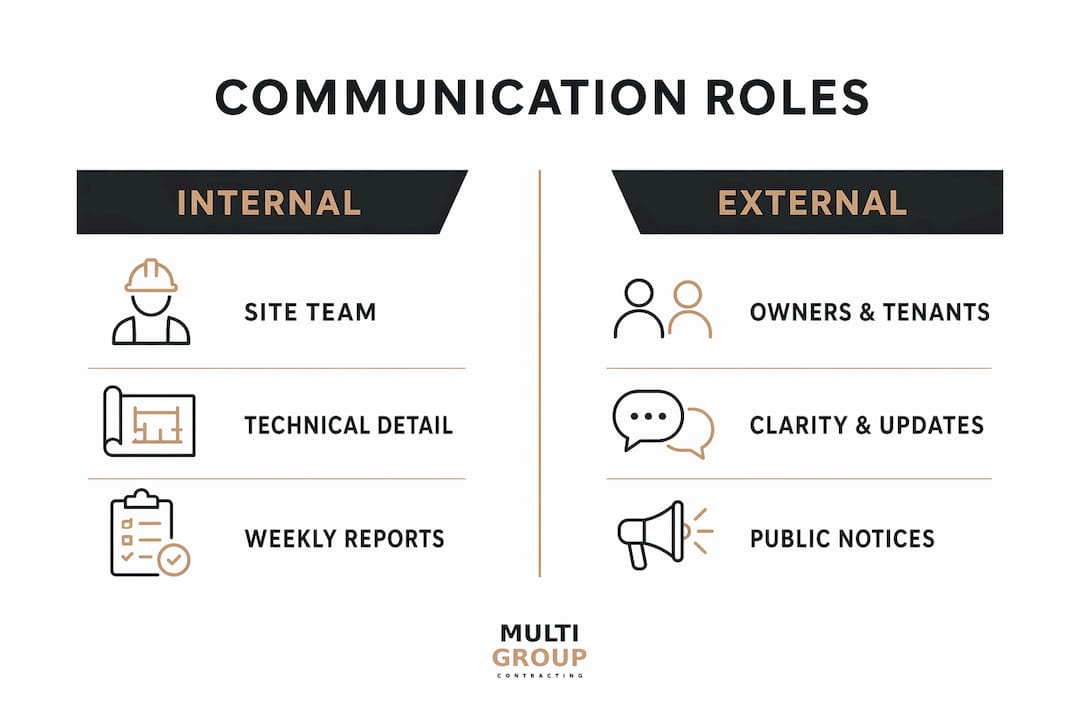
Internal and external stakeholders have fundamentally different communication needs. Treating them the same is one of the most common and costly mistakes on construction projects.

Internal audiences, such as site superintendents, subcontractors, and project engineers, need technical detail. They work from drawings, specifications, and schedules. Their updates should include precise measurements, material specifications, and sequencing information. Ambiguity at this level causes rework, and rework costs money.
External audiences, including property owners, retail tenants, municipal permit offices, and the public, need clarity and simplicity. They do not need to know the gauge of the steel studs. They need to know whether the project is on schedule, what disruptions to expect, and when decisions are required from them. Overloading external stakeholders with technical detail creates confusion and erodes trust.
| Stakeholder type | Communication style | Typical formats |
|---|---|---|
| Internal (trades, site team) | Technical, detailed, frequent | Daily logs, RFIs, drawing markups |
| Internal (project manager, PM team) | Summary with detail on request | Weekly reports, schedule updates |
| External (owner, tenant) | Plain language, milestone-focused | Monthly summaries, decision memos |
| External (municipality, regulators) | Formal, compliance-focused | Permit submissions, inspection notices |
Confidentiality is also a factor. Financial details, legal correspondence, and dispute records should never reach external parties without legal review. Build this boundary into your communication plan from day one.
Pro Tip: Create two versions of your weekly project update: a technical version for the site team and a plain-language version for the owner or tenant. It takes 20 extra minutes and prevents hours of clarification calls.
Distinguishing internal from external needs is the key to managing expectations and preventing stakeholder resistance. On Metro Vancouver commercial projects, where tenants may still be operating in adjacent spaces during a renovation, this distinction directly affects business relationships and project reputation.
What are the best communication tools for construction projects?
The best communication tools for construction projects are those that centralise information and create a clear audit trail. Email alone does not meet this standard. Successful Canadian project teams log all change orders and site deviations in real time using centralised documentation systems. This approach protects all parties and reduces disputes.
Effective tools and practices include:
- Centralised project management platforms: Cloud-based platforms that store drawings, RFIs, submittals, and change orders in one location accessible to all authorised parties. Every action is timestamped and attributed to a user.
- Mobile field apps: Allow site superintendents and trades to log daily reports, upload photos, and flag issues directly from the jobsite. This eliminates the lag between an event occurring and it being recorded.
- Structured coordination meetings: Weekly or bi-weekly site meetings with a fixed agenda, a designated minute-taker, and distributed minutes within 24 hours. Verbal agreements made in meetings must be captured in writing.
- Change order logs: A live register of every approved and pending change, including cost impact and schedule effect. This document is referenced at every progress meeting.
- Drawing revision control: A clear system for issuing and superseding drawings, so the site team always works from the current version.
Communication and planning deficiencies.cpm-09) are among the most critical performance factors identified by construction professionals. The right tools reduce these deficiencies by making information visible and accessible rather than buried in individual inboxes.
Pro Tip: Set a rule that no verbal instruction on site is valid until it appears in writing in the project management platform. This single habit eliminates the majority of “he said, she said” disputes.
The role of the project manager in enforcing these tools and habits is critical. A platform that no one uses consistently is worse than a shared spreadsheet that everyone updates.
How to implement communication throughout a construction project lifecycle
Strong communication does not happen by accident. It requires deliberate setup at the start of a project and consistent maintenance through to close-out.
-
Define communication requirements during pre-construction. Before the first shovel goes in the ground, the project manager documents the communication plan as part of the Project Management Plan. This includes stakeholder identification, information types, formats, frequency, and roles.
-
Integrate the plan into contracts and Division 01. Communication obligations become legally binding when they appear in the contract documents. Division 01 of the construction specifications is the standard location for these requirements in Canadian projects.
-
Hold a project kick-off meeting. All key parties attend and confirm they understand the communication protocols. Meeting minutes from this session serve as the baseline record.
-
Monitor communication frequency and channels throughout construction. If a stakeholder stops responding to weekly reports, that is a signal. The project manager adjusts the format or frequency before the silence becomes a dispute.
-
Conduct a communication audit at project close-out. Review what worked and what did not. Post-project communication audits identify information flow issues and feed directly into improved processes for the next project.
The table below maps communication activities to project phases:
| Project phase | Key communication activities |
|---|---|
| Pre-construction | Stakeholder register, communication plan, kick-off meeting |
| Design and permitting | RFI management, permit submission updates, design review meetings |
| Construction | Weekly progress reports, change order logs, daily site logs |
| Substantial completion | Deficiency lists, occupancy permit coordination, owner handover |
| Close-out | Final documentation, communication audit, lessons learned |
Canadian construction projects face unique complexity due to decentralised structures and diverse stakeholder groups. Formalising communication management absorbs that complexity and provides consistent stakeholder engagement across every phase. The commercial construction best practices used by experienced Metro Vancouver contractors reflect this reality: the teams that communicate well finish on time and on budget far more consistently than those that do not.
Key takeaways
Structured, role-specific communication is the most direct way to prevent cost overruns, rework, and disputes on any construction project.
| Point | Details |
|---|---|
| Communication plan is foundational | Define stakeholder roles, formats, and frequency before construction begins. |
| Division 01 makes it binding | Communication requirements in Division 01 and the Project Management Plan carry legal weight. |
| Internal and external needs differ | Technical detail for the site team; plain language and milestones for owners and tenants. |
| Centralise documentation | Real-time, centralised logs of change orders and site deviations protect all parties. |
| Audit after every project | Post-project communication reviews identify gaps and improve future project processes. |
What I have learned from managing communication on Vancouver construction projects
After working on commercial renovations, tenant improvements, and warehouse builds across Metro Vancouver, the pattern is consistent. Projects that struggle almost always have the same root problem: communication was treated as an afterthought rather than a management discipline.
The most common mistake I see is the assumption that experienced trades and consultants will “figure it out.” They will not. Without a defined escalation path, a change order log, and a weekly meeting with minutes, information fragments across text messages, emails, and verbal conversations. By the time the dispute surfaces, no one can reconstruct what was agreed and when.
The second mistake is using the same communication approach for every stakeholder. A retail tenant in a Burnaby strip mall does not need to know about the structural engineer’s RFI. They need to know when their space will be ready and what disruptions to expect next week. Sending them a 40-page progress report does not build confidence. It creates anxiety.
What actually works is treating communication as a system. Define it, assign ownership, and enforce it consistently. When a project manager at Multigroup sets up a communication plan on day one, it is not bureaucracy. It is the structure that lets every other part of the project run cleanly. BC Building Code compliance, permit coordination, subcontractor scheduling, and budget management all depend on clear, timely information moving to the right people at the right time.
The teams that institutionalise this approach do not just finish projects. They build the kind of client relationships that generate repeat work and referrals.
— MultigroupTeam
Multigroup’s approach to construction communication in Metro Vancouver
Multigroup brings structured communication practices to every commercial renovation and tenant improvement project across Metro Vancouver, from initial permit applications through to final handover.
Every Multigroup project begins with a defined communication plan that identifies stakeholders, assigns reporting responsibilities, and establishes a centralised documentation system. Clients receive plain-language progress updates on a regular schedule, while the site team operates from a live change order log and daily site reports. BC Building Code compliance and permit coordination are tracked and communicated at every phase. For property managers, business owners, and developers planning a tenant improvement or commercial build in Burnaby, Richmond, Surrey, or anywhere in the Metro Vancouver region, Multigroup provides the project management structure and communication discipline that keeps builds on schedule and on budget.
FAQ
What is a construction project communication plan?
A construction project communication plan is a formal document that defines who receives what information, in what format, and how often throughout a project. It assigns communication responsibilities to specific roles and is typically integrated into the Project Management Plan and Division 01 of the construction specifications.
Why does poor communication cause construction projects to fail?
Poor communication contributes to 56% of failed construction projects by creating gaps in accountability, unresolved scope changes, and misaligned stakeholder expectations. These gaps lead to rework, budget overruns, and disputes that are difficult to resolve without a documented record.
Where are communication requirements found in construction contracts?
Communication requirements are typically codified in Division 01 of the construction specifications and in the Project Management Plan. These sections carry legal weight and define the obligations of all parties regarding information sharing and reporting.
How often should a construction project team hold coordination meetings?
Weekly or bi-weekly coordination meetings are standard practice on active construction projects. Meeting minutes must be distributed within 24 hours and serve as the written record of all decisions and action items discussed.
What is a post-project communication audit?
A post-project communication audit is a structured review of how information flowed during a completed project. It identifies breakdowns and successes in the communication process and produces recommendations that improve communication practices on future projects.