
A project manager protects the owner’s budget, schedule, and risk from the outside; a contractor executes the physical work on-site. Hire a general contractor alone for a straightforward, single-trade job, and add a project manager once your project involves multiple stakeholders, complex permitting, or a budget you cannot afford to lose control of.
- Small or simple job: one licensed general contractor (GC) is usually enough.
- Complex, multi-stakeholder, or high-budget job: pair a project manager (PM) with a GC, and budget separately for each fee.
In many complex commercial builds, a project manager acts as the owner’s representative with higher-level oversight, often supervising the construction manager or GC directly to keep the owner’s goals on track.
TL;DR:
- A project manager starts early in pre-construction to reduce risks related to permits, design, and budget, especially for complex projects with multiple stakeholders.
- General contractors focus on site execution, holding responsibility for daily site management, subcontractor coordination, and delivering on time and budget, with fee structures affecting their incentives.
- For small, straightforward jobs, a licensed GC alone suffices, but complex or multi-trade projects generally require both a PM and a GC, with separate fee considerations around 3% to 8% for PMs and 8% to 20% markups for GCs.
- Contractual clarity is key; owners must verify decision-making authority and who holds final sign-off on change orders, regardless of job title.
- Multigroup offers integrated GC and PM services under one contract for projects of all sizes, simplifying coordination for owners managing multi-trade or permit-heavy developments.
Table of Contents
- Project manager responsibilities: where oversight actually adds value
- General contractor responsibilities: execution and accountability on-site
- How do a contractor and project manager compare on a real project?
- How do I decide between hiring a contractor or a project manager?
- What do contractors and project managers typically charge?
- Multigroup: contracting and project management under one roof.
- Key Takeaways
- Why owners get this comparison wrong
- Get a contractor and project manager working for you, not against each other
- Sources
- FAQ
Project manager responsibilities: where oversight actually adds value
A project manager works for the owner, not the job site. Their job is to protect budget, schedule, quality, and risk before a single wall gets framed. That means feasibility studies, permit strategy, and design coordination happen under a PM’s watch long before a GC ever mobilizes crews.

Timing matters more than most owners realize. Engaging a PM in pre-construction reduces budget and schedule risks that become expensive, sometimes impossible, to fix once construction starts. A PM caught midway through a job is playing defence; one hired at day one is playing offence.
PMs typically bill under a professional services agreement, not a construction contract. That distinction shapes incentives: a GC protects margin on a build contract, while a PM’s fee structure ties more directly to protecting the owner’s investment. Deliverables usually include:
- Risk registers that flag budget overruns while there’s still time to act.
- Vendor procurement recommendations and bid comparisons.
- Progress reports tracking schedule against the original baseline.
- Design coordination between architects, engineers, and the eventual contractor.
Pro Tip: Ask a prospective PM to show you a sample risk register from a past project. If they can’t produce one, they’re likely acting as a scheduler, not a governance function.
Read more on what a project manager actually does day to day on an owner’s behalf.
General contractor responsibilities: execution and accountability on-site
A general contractor is the entity physically responsible for turning drawings into a finished space. Site management, subcontractor procurement, and daily quality control all sit on the GC’s desk, and the GC carries the commercial risk of getting the build done on time and on budget under whatever contract they signed.
Three commercial models shape how a GC gets paid, and each shifts incentives differently:
- Lump-sum (fixed-price): the GC quotes one number and absorbs cost overruns, which rewards tight estimating but can incentivize corner-cutting on unforeseen conditions.
- Negotiated fee: the GC’s profit is a set percentage or flat fee on top of documented costs, giving more transparency but less pressure to control spend.
- Cost-plus: the owner pays actual costs plus a fee, useful for scope-fluid projects but requiring active oversight to avoid drift.
Before signing anything, confirm the GC’s licensing, insurance, and compliance with local building codes, including BC Building Code standards if your project sits in British Columbia. An licensed contractor BC status isn’t optional paperwork, it’s your legal protection if something goes wrong mid-build. Once mobilized, expect a construction schedule, daily site logs, and a punchlist process at closeout as standard deliverables. For a deeper look at how construction managers keep Metro Vancouver builds on track, see how construction managers ensure project success in this market.
How do a contractor and project manager compare on a real project?
Construction managers focus on day-to-day field operations, while project managers handle broader coordination and owner-side objectives. The exact split shifts depending on delivery method, but the following mapping holds across most Metro Vancouver commercial and residential projects:
- Primary focus: a PM protects the owner’s budget, schedule, and risk exposure; a GC delivers the physical build to spec.
- Phase of involvement: a PM typically starts in pre-construction (feasibility, permits, design) and stays through closeout; a GC usually joins once design is locked and construction is ready to mobilize.
- Reporting and accountability: a PM reports directly to the owner or developer; a GC reports to whoever holds the construction contract, which may be the owner or, on larger jobs, the PM.
- Typical fee structure: PM fees run as a percentage of project cost, hourly rate, or retainer; GC fees appear as lump-sum, negotiated fee, or cost-plus markup.
- Best for: PM oversight suits multi-stakeholder or high-permit-risk projects; GC-only suits single-tenant, single-trade-dominant jobs with a clear scope.
Applied to real scenarios: a small residential kitchen renovation rarely needs a PM, a licensed GC handles design input and execution directly. A mid-size tenant improvement, say a 3,000 square foot retail buildout with new mechanical and electrical work, often benefits from a PM coordinating permits and multiple trades even when Multigroup manages construction. A larger commercial fit-out spanning several floors or multiple tenants almost always performs better with a dedicated PM managing the GC relationship and protecting the owner’s capital budget.
How do I decide between hiring a contractor or a project manager?
Base the decision on five factors: total budget, project complexity, permit risk, number of trades involved, and how many stakeholders need to sign off on decisions. A single-owner coffee shop renovation with one trade sequence rarely justifies a separate PM. A medical clinic buildout with layered permitting, multiple specialty trades, and a landlord approval process usually does.
Ask any contractor or PM candidate these five questions before signing:
- Who carries the financial risk if the schedule slips, you or them?
- How do you get paid if the project scope changes mid-build?
- Can you show me a schedule and risk register from a comparable project?
- Who has final sign-off authority on change orders?
- What happens to your fee if the project comes in over budget?
Pro Tip: If a GC can’t clearly separate their execution role from owner-side decisions, that’s a red flag. Vague answers on accountability usually mean you need independent PM oversight before you sign anything.
Owners juggling multiple permits, several trades, or more than two decision-making stakeholders should lean toward hiring a PM even on a mid-size job. Review project phases before locking in your decision.
What do contractors and project managers typically charge?
PM fees commonly run as a management fee, hourly rate, or percentage of total project cost, generally landing between 3% and 8% of construction value. GC fees usually appear as a markup on cost (8% to 20%) or a straight lump-sum bid.
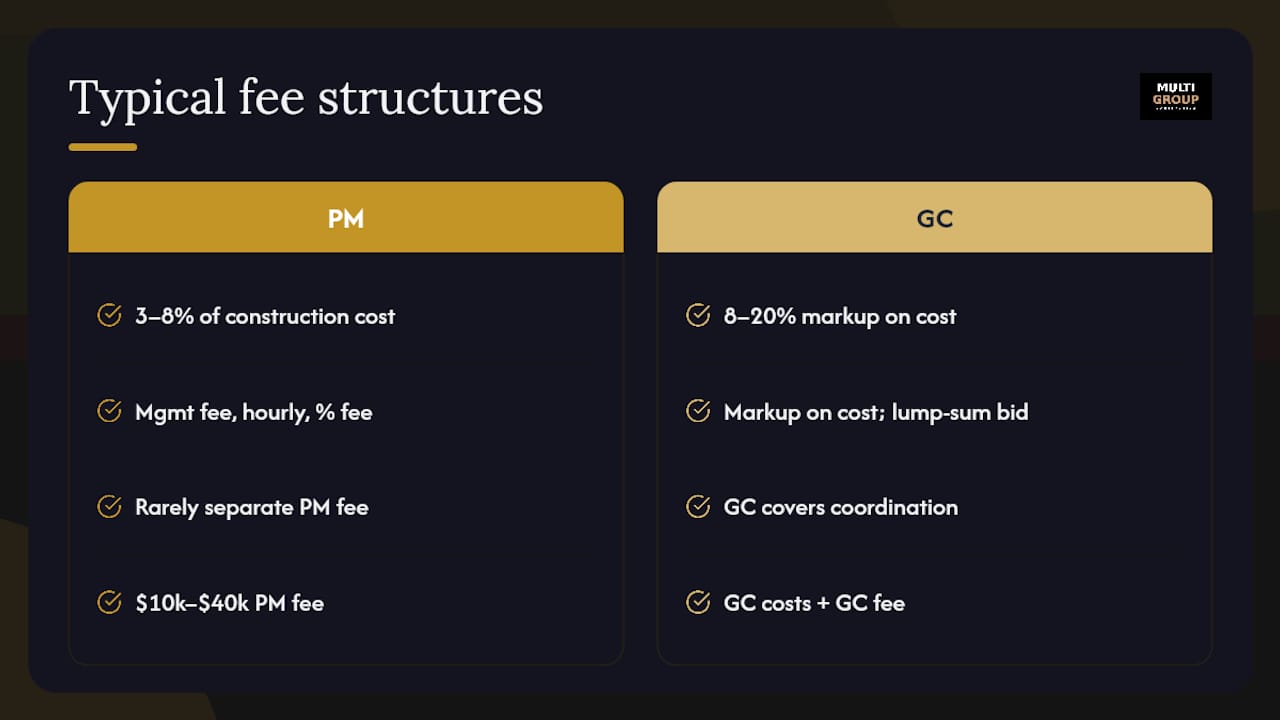
For budgeting purposes in CAD: a small residential renovation ($50,000 to $150,000) rarely needs separate PM fees beyond the GC’s own coordination. A mid-size tenant improvement ($200,000 to $800,000) might carry a PM fee of $10,000 to $40,000 on top of GC costs. A larger commercial fit-out above $1 million often sees PM fees in the $50,000 to $100,000 range, justified by the budget protection they provide. Delivery method matters too. Construction manager at risk (CMAR) and design-build structures bundle fees differently than a straightforward fixed-price GC contract, so compare proposals on the same basis before deciding.
Who has more authority: the contractor or the project manager?
Authority comes from the contract, not the job title. On owner-hired PM projects, the PM typically supervises the construction manager or GC. On GC-as-prime projects, the CM may work as a GC employee instead of an owner’s representative. The terms PM, CM, and GC are used inconsistently across the industry.
- Read the contract’s decision-authority clause before signing, not after a dispute starts.
- Confirm in writing who approves change orders and who signs off on final payment.
Multigroup: contracting and project management under one roof.
Multigroup Contracting is a licensed contractor BC operating across Metro Vancouver, including Burnaby, Richmond, Surrey, Coquitlam, North Vancouver, West Vancouver, New Westminster, Langley, and Delta, plus Seattle WA and Portland OR. Every project runs through BC Building Code compliance, full permit handling, and structured project management, so owners get GC execution and PM-level oversight from one team.
Service mapping for common reader scenarios:
- Retail franchisees: retail buildout projects with tight opening deadlines.
- Restaurant and coffee shop operators: MEP-heavy renovations requiring health permit coordination.
- Warehouse and industrial owners: structural and code-driven warehouse renovation BC work.
- Office and medical clinic owners: office renovation Metro Vancouver and leasehold improvement projects.
- Property managers and developers: tenant improvement contractor services across multi-tenant buildings.
Owners who ask about licensing, permit strategy, and who holds decision authority on day one avoid the disputes that sink budgets later. That’s the conversation worth having before any contract gets signed.
Three questions worth asking on first contact: who handles permit submissions, how are change orders priced, and who is the single point of contact through closeout.
Key Takeaways
The distinction that matters most is accountability structure, not job title: a project manager governs the owner’s interests while a contractor executes the physical build under contract terms that define who carries the risk.
| Point | Details |
|---|---|
| Match hire to complexity | Use a GC alone for simple, single-trade jobs; add a PM for multi-stakeholder or high-permit-risk projects. |
| Engage a PM early | Pre-construction involvement reduces budget and schedule risks that are costly to fix later. |
| Confirm contract authority | Read the decision-authority clause; job titles don’t determine who has final sign-off. |
| Budget both fee types | PM fees run roughly 3% to 8% of project cost; GC markups typically fall between 8% and 20%. |
| Multigroup covers both roles | Multigroup delivers licensed GC execution and owner-side project management across Metro Vancouver under one contract. |
Primary sources and Multigroup pages
- Autodesk Construction Cloud, Procore, and Project Management Formula informed the role definitions above.
- Ready to hire? Review Tenant Improvements or Commercial Renovation Vancouver.
Why owners get this comparison wrong
Most owners treat “contractor vs project manager” as a budget question first: can I afford both fees? That’s backwards. The right question is risk exposure. A $300,000 tenant improvement with one landlord and one trade sequence carries low coordination risk, a GC alone handles it fine. The same budget spent on a multi-tenant medical clinic with layered permits and three stakeholders signing off on design changes carries real risk of scope creep and schedule slippage that no GC contract structure protects against, because a GC is incentivized to protect their own margin, not your investment.
The conventional advice, “hire a PM if your budget is large enough,” misses this. Budget size correlates with complexity but doesn’t cause it. A modest but permit-heavy restaurant buildout can need more owner-side oversight than a much larger, simpler warehouse shell. Owners should prioritize counting stakeholders and permit dependencies before they count dollars. That reframing changes the hire decision earlier, when it still saves money instead of just explaining, after the fact, why a budget ran over.
— MultigroupTeam
Get a contractor and project manager working for you, not against each other
Multigroup is the alternative to hiring a GC and a separate PM firm and hoping they coordinate. Every project comes with permit handling, BC Building Code compliance, and owner-side scheduling built into the same contract, so you’re not paying two overhead structures or managing a handoff between them.

That structure suits property managers juggling multiple tenant improvements, restaurant operators racing a lease clock, and medical clinic owners who can’t afford a permit delay. Whether the job is a warehouse renovation, an office renovation, or a restaurant and coffee shop renovation, the same team handles both execution and oversight from first permit application to final punchlist. Trade-specific coordination, like the plumbing project manager role described by Petra Resourcing, shows how much smoother multi-trade jobs run when someone owns coordination end to end. Contact Multigroup to walk through your project scope and get a CAD-based estimate before you commit to a delivery structure.
Sources
- Project manager vs construction manager | Autodesk Construction Cloud
- General contractor vs project manager | Project Management Formula
- Construction manager vs general contractor | Procore
FAQ
Who is higher, a construction manager or a project manager?
It depends on the contract, not the title. On owner-hired PM projects, the project manager typically supervises the construction manager, but on GC-as-prime projects, the CM may report directly to the general contractor instead.
Who is higher than a project manager?
On most complex commercial builds, the owner sits above the project manager, since the PM works as the owner’s representative and reports directly to them. On very large developments, a program manager overseeing multiple projects may sit above individual PMs.
Is a construction manager or a project manager better for my project?
Neither is universally better. A construction manager suits day-to-day field execution, while a project manager suits owners who need governance over budget, schedule, and multiple stakeholders. Multigroup’s integrated model offers both under one contract.
What’s the core difference between a contractor and a project manager?
A contractor executes the physical construction work under a build contract, while a project manager represents the owner’s interests, overseeing budget, schedule, and risk from before construction starts through closeout.
Do I need both a contractor and a project manager?
Simple, single-trade projects usually need only a licensed general contractor. Complex projects with multiple stakeholders, heavy permitting, or a large capital budget benefit from adding project manager oversight alongside the contractor.