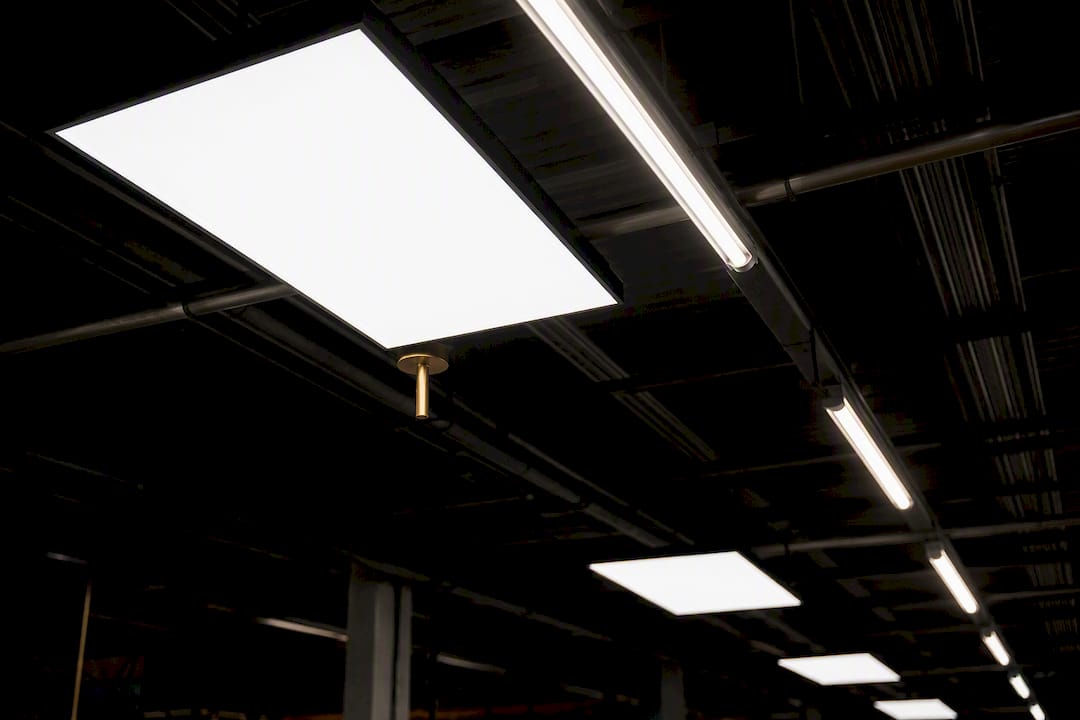
LED is the better choice for nearly every commercial application, delivering longer lifespans, lower energy use, and faster payback than fluorescent systems. A University of Michigan study measured energy savings up to 44% from tube swaps alone, and Canadian retrofit rebate programs shorten payback further. Fluorescent still has a narrow case: matching existing fixtures on a tight renovation budget before a full retrofit.
TL;DR:
- LEDs can reduce energy consumption by up to 44 percent compared to fluorescent tubes, often leading to payback periods of 1 to 3 years with rebates.
- Upgrading to integrated LED fixtures offers better long-term control and rebate eligibility, especially for spaces with long hours or high fixture counts.
- Fluorescent systems typically last 10,000 to 30,000 hours and require ongoing maintenance for ballasts and lamps, whereas LEDs last over 50,000 hours with minimal upkeep.
- Replacing fluorescent lights in occupied buildings involves permits if wiring or control systems are touched, and integrating controls during retrofit enhances value and efficiency.
- LEDs are environmentally safer, with no mercury content, and produce negligible UV, making disposal simpler and aligning with regulatory deadlines.
Table of Contents
- LED vs fluorescent lighting: how the technology actually works
- What is fluorescent lighting and how does it differ from LED?
- How much energy do LEDs actually save over fluorescent lighting?
- How do LED and fluorescent lifespans compare in real operating hours?
- What does an LED retrofit cost and how fast does it pay back?
- What retrofit path fits your fixtures: Type A, B, or C?
- Where does LED lighting deliver the biggest advantage by space type?
- Are LED lights safer than fluorescent for people and the environment?
- When does an LED retrofit become a permitting or contractor project?
- LED vs fluorescent lighting: final checklist before you commit
- A contractor’s view on lighting retrofits that actually deliver
- How Multigroup handles commercial LED retrofits
- Sources
- FAQ
LED vs fluorescent lighting: how the technology actually works
LEDs produce light directly through a semiconductor chip, converting electricity to light with far less wasted heat than a fluorescent tube. That efficiency is why LED fixtures now dominate new commercial construction and most retrofit specifications across Metro Vancouver.
Commercial buyers will run into a few standard categories:
- Integrated LED fixtures — the light source and driver are built as one unit, rated for the full life of the fixture.
- LED retrofit lamps — screw-in or tube-style LEDs designed to fit existing fluorescent housings.
- High-bay and troffer LEDs — application-specific fixtures for warehouses, offices, and drop-ceiling grids.
Efficacy ranges from roughly 100 to over 150 lumens per watt depending on fixture class, with rated lifespans between 50,000 and 100,000 hours. Integrated fixtures cost more upfront than retrofit lamps but typically qualify for stronger utility rebates and better controls integration, a trade-off worth weighing before locking in a spec.
What is fluorescent lighting and how does it differ from LED?
Fluorescent lighting excites mercury vapour inside a glass tube, and the resulting UV light strikes a phosphor coating to produce visible light. That process needs a ballast, and ballast losses mean the system draws more watts than the lamp label alone suggests.
Key differences that matter for facility budgets:
- Magnetic ballasts run hotter and less efficiently than electronic ballasts, adding measurable system watts.
- Rated lamp life typically runs 10,000 to 30,000 hours, well short of comparable LED products.
- Cold starts and warm-up lag are normal, and lamps dim and shift colour as they age.
- Ballast failures are a recurring maintenance line item that LED fixtures largely eliminate.
Fluorescent systems also lose output over their rated life faster than LEDs, so the light you get in year three is noticeably dimmer than what you installed.
How much energy do LEDs actually save over fluorescent lighting?
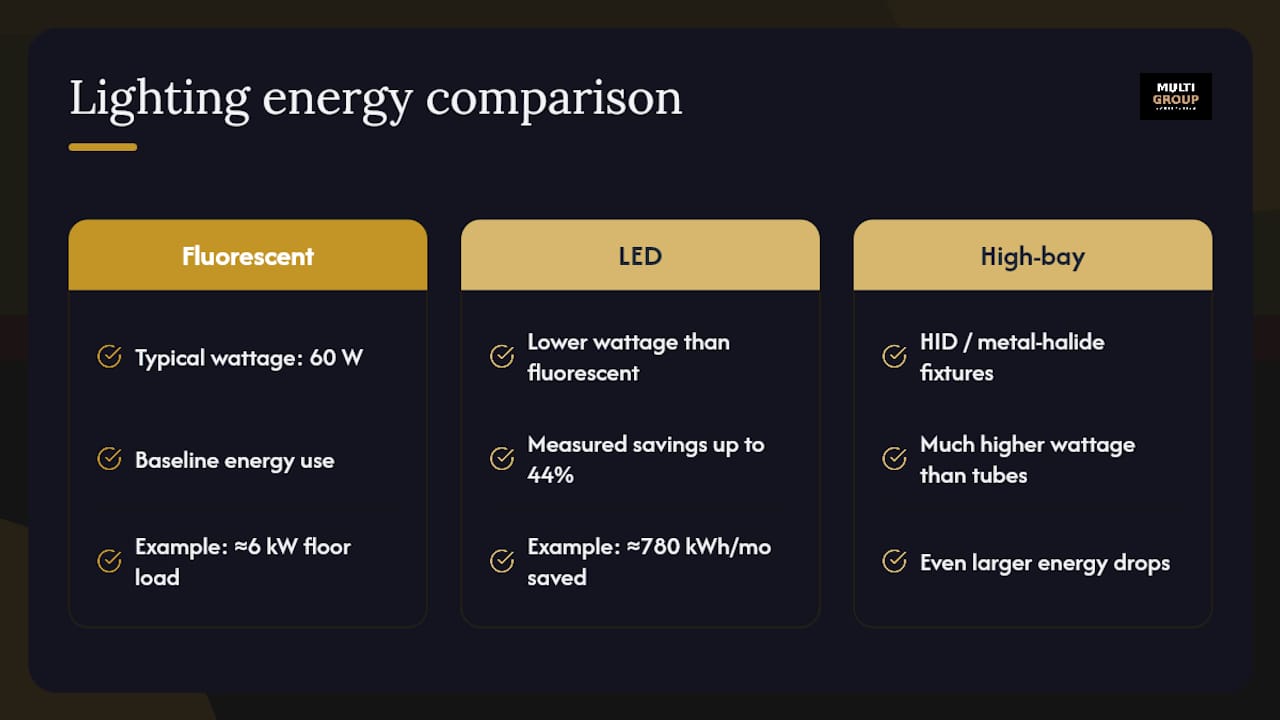
LEDs cut lighting energy use by a substantial amount compared to fluorescent systems in typical commercial retrofits, according to Canadian retrofit calculator data. That range holds across office, retail, and warehouse applications, with high-bay replacements often showing the largest gains.
Statistic callout: A University of Michigan study found that swapping 4-foot fluorescent tubes for LED equivalents produced energy savings of up to 44% in measured installations, without touching controls or occupancy behaviour.
Run the math on a mid-size commercial space: a floor with 100 fluorescent troffers averaging 60 watts per fixture draws 6 kilowatts when fully lit. At 12 hours a day, 5 days a week, that’s roughly 780 fewer kilowatt-hours consumed monthly, before any savings from occupancy sensors or daylight harvesting are added. At typical commercial electricity rates, that’s real monthly dollars back into operating budgets, compounding over a fixture life measured in years, not months.
Warehouses replacing HID or metal halide high-bays see even steeper drops, since those fixtures draw far more wattage than fluorescent tubes to begin with.
How do LED and fluorescent lifespans compare in real operating hours?
LED fixtures last two to five times longer than fluorescent lamps in real operating hours, directly cutting replacement labour, lift rentals, and disposal costs over a building’s holding period. That gap widens further once ballast failures are factored into fluorescent maintenance budgets.
- Fluorescent tubes rated at 20,000 hours run out in roughly 4.5 years at 12 hours a day.
- LED fixtures rated at 50,000 hours run 11+ years on the same schedule, per retrofit lifespan data.
- Ballast replacement typically adds parts and labour costs fluorescent systems incur repeatedly over that same period.
- LED drivers fail less often and rarely require the same reactive maintenance visits.
Pro Tip: Schedule lighting retrofits alongside other above-ceiling work whenever possible. Bundling lift rentals across trades cuts access costs significantly compared to bringing in equipment solely for lamp changes.
What does an LED retrofit cost and how fast does it pay back?
Upfront costs for LED fixtures run higher than fluorescent equivalents, but provincial rebates and lower operating costs typically bring commercial payback down to 1 to 3 years. Installation labour, not the fixture itself, is often the largest cost driver in older buildings with outdated wiring.
- LED troffers and high-bays typically cost more per fixture than fluorescent equivalents before rebates.
- Provincial utilities including Ontario, BC, and Nova Scotia programs commonly offer $5 to $25 per fixture in rebates, depending on fixture type and program.
- Capital Cost Allowance classes apply to lighting equipment, and a tax professional can confirm which class and rate applies to a given retrofit.
Statistic callout: Combined utility rebates and reduced energy draw bring typical commercial payback to 1 to 3 years across most Canadian retrofit projects, with high-bay warehouse swaps sometimes paying back in under two years without any rebate at all.
Buildings weighing a broader capital plan should read Multigroup’s guide on why retrofitting commercial space delivers measurable returns before scoping the lighting line item in isolation.
What retrofit path fits your fixtures: Type A, B, or C?
Retrofit lamps fall into three categories that determine installation complexity and whether an electrician needs to touch the fixture wiring. Choosing wrong adds cost and risk, so match the type to your existing infrastructure and long-term controls plans before ordering product.
- Type A lamps plug directly into an existing fluorescent ballast, requiring no rewiring. This is the fastest, cheapest path, but it inherits ballast failure risk and limits dimming.
- Type B lamps bypass the ballast entirely and wire directly to line voltage, removing the ballast as a failure point but requiring an electrician to modify each fixture.
- Type C lamps run off an external LED driver, offering the best dimming and controls compatibility but the highest install complexity.
Facilities planning occupancy sensors, daylight harvesting, or dimming should generally skip screw-in retrofits and move to integrated fixtures, since controls compatibility and rebate eligibility are usually stronger. Any project touching branch circuits, emergency lighting, or fixture-mounted wiring should involve a licensed electrical contractor, not a maintenance crew working alone.
Where does LED lighting deliver the biggest advantage by space type?
LEDs deliver the strongest return in spaces with long daily runtimes and high fixture counts, where energy savings and maintenance reductions compound fastest. Offices and retail spaces gain more on light quality and control than raw energy savings alone.
- Warehouses and cold storage see the fastest payback, since LEDs start instantly in cold temperatures and fluorescent output drops sharply below 10°C.
- Offices and retail benefit from LED’s higher colour rendering index (CRI), which renders merchandise and skin tones more accurately than most fluorescent tubes.
- 24-hour or long-run operations compound energy savings fastest given the sheer hours of runtime.
- Heritage or leased spaces with fixed fixture specifications sometimes justify fluorescent lamps temporarily, pending a full base-building upgrade.
Tenants planning a retail fit-out should review lighting alongside the full scope in Multigroup’s retail buildout services, since lighting design and layout typically get finalized during the same permitting package.
Are LED lights safer than fluorescent for people and the environment?
LEDs contain no mercury and produce negligible UV output, while fluorescent lamps require hazardous-waste handling at end of life due to their mercury content. That disposal difference alone is pushing many facility teams toward LED ahead of regulatory deadlines in some jurisdictions.
- Spent fluorescent tubes must go through certified hazardous-waste recycling, not standard disposal.
- LED fixtures avoid this handling requirement entirely, simplifying decommissioning.
- Poor-quality LED drivers can introduce flicker, and a review of light and health research links flicker and certain spectral characteristics to visual discomfort and headaches in sensitive people.
- Specifying flicker-free drivers with documented compliance avoids this issue on new installs.
When does an LED retrofit become a permitting or contractor project?
A lighting swap becomes a regulated construction project the moment it touches emergency circuits, exit path luminaires, or control wiring, not simply because fixtures are being replaced. Property managers who treat every retrofit as a maintenance task risk failed inspections and rework.
- Retrofits altering emergency lighting or control strategy often require documented acceptance testing under municipal building code enforcement.
- Occupied-building sequencing matters: staging work to minimize lift use and scheduling around tenant hours reduces both labour cost and disruption.
- Ballast disposal and confined-space ceiling access should be budgeted as line items, not assumed into a base quote.
- Integrated fixtures with controls generally deliver the best long-term value once rebate eligibility and reduced runtime are factored in.
Multigroup’s guide to why upgrading building systems pays off for property owners covers how lighting fits into a broader capital planning cycle.
LED vs fluorescent lighting: final checklist before you commit
Choose LED for any space running more than a few hours a day, and default to integrated fixtures over screw-in retrofits whenever controls or rebate eligibility matter. Fluorescent remains defensible only as a short-term bridge before a planned full retrofit.
- Confirm daily runtime hours: anything over 8 to 10 hours strongly favours LED on payback alone.
- Check current provincial rebate rates before finalizing a fixture spec.
- Decide whether dimming, occupancy sensors, or daylight harvesting matter, since that determines Type A/B/C or integrated fixture choice.
- Pilot one floor or zone before committing to a full-building rollout, and write controls compatibility into the RFP scope explicitly.
| Factor | LED | Fluorescent |
|---|---|---|
| Energy use / efficacy | 100–150+ lumens per watt | Lower efficacy; ballast losses add system watts |
| Typical lifespan | 50,000–100,000 hours | 10,000–30,000 hours |
| Maintenance needs | Minimal; drivers rarely fail | Recurring ballast and lamp replacement |
| Upfront cost and payback | Higher upfront; 1–3 year payback with rebates | Lower upfront; no rebate incentive |
| Light quality and controls | Higher CRI; dimming and sensor compatible | Lower CRI; limited dimming options |
| Environmental / disposal impact | No mercury; simple disposal | Mercury; requires hazardous-waste handling |
A contractor’s view on lighting retrofits that actually deliver
Multigroup has scoped lighting retrofits inside occupied warehouses, offices, and retail spaces across Metro Vancouver, and the pattern holds: projects that plan controls and permitting upfront finish faster and cheaper than those treating it as a simple swap. As a licensed and insured commercial general contractor, Multigroup sequences electrical, permitting, and tenant coordination as one scope, not three separate headaches. Property managers consistently prioritize minimal disruption and predictable budgets over the cheapest per-fixture price. Review Multigroup’s project portfolio or request a site estimate to see how a properly sequenced retrofit runs.
— MultigroupTeam
How Multigroup handles commercial LED retrofits
Multigroup runs LED retrofits as part of broader tenant improvement, warehouse renovation, and retail buildout scopes, which means lighting gets coordinated with electrical capacity, ceiling work, and permitting instead of being bolted on separately. That coordination is where most facility teams lose time and money on retrofits handled piecemeal by multiple trades.
A typical engagement starts with a site survey to confirm existing fixture types, ballast conditions, and control wiring, followed by a detailed estimate and permit review before any work begins. For warehouses and industrial buildings, Multigroup’s warehouse renovation services fold high-bay lighting into the same scope as racking clearances and dock work. For restaurants and coffee shops, lighting design gets tied directly into renovation planning so ambiance and CRI requirements are addressed before permits are pulled. Property managers running multi-site rollouts should also see Multigroup’s tenant improvement services for phased execution across occupied units. Facilities teams weighing HVAC upgrades alongside lighting can reference Strong Heating & Cooling’s guide to commercial HVAC efficiency upgrades for a whole-building view. To scope a retrofit or full commercial construction project, request a site visit and estimate through Multigroup’s contact page.
Sources
- Study examines switching from fluorescent lamps to LEDs — University of Michigan (Record)
- Canada LED Lighting Retrofit Calculator 2026 - ROI | Calculory AI
- Publication on light and health (PMC)
- High bay LED lamp versus integrated fixture for warehouses in Ontario — Luma Energy
FAQ
Should I replace fluorescent lights with LEDs?
Yes, in almost every commercial setting, LED replacement pays back through energy savings, reduced maintenance, and utility rebates within 1 to 3 years in most Canadian projects.
When should you not use LED bulbs?
Fluorescent may still make sense short-term when a fixed fixture housing must match existing stock exactly or when capital budget forces a delay ahead of a planned full retrofit.
How can I tell if my lighting is fluorescent or LED?
Fluorescent tubes have visible glass with a slight warm-up delay and flicker on start, while LED tubes or fixtures light instantly at full brightness with no visible tube glow pattern.
Are LED lights better for you than fluorescent lights?
LEDs generally cause less flicker-related visual discomfort than older fluorescent ballasts, and a review of lighting and health research links flicker to headaches and photophobia in sensitive individuals, though driver quality matters for both technologies.