A progress draw is a staged loan advance released by your lender when a verified construction milestone is complete. Rather than receiving the full mortgage amount upfront, you draw funds in portions tied to inspections, appraisals, and documented build stages. The key players are your lender, your contractor, a third-party inspector, and a real estate lawyer who confirms no liens have been registered before each release. The single most important planning step: negotiate and attach a bespoke draw schedule to your construction contract before any work begins.
Before you accept any draw schedule, confirm these five things:
- Down payment and lender coverage: Canadian construction mortgages typically require a higher down payment than conventional mortgages; confirm the down payment your lender requires before you commit.
- Statutory holdback rules: In most provinces, 10% of each draw must be retained by law to protect subcontractors and suppliers against unpaid claims.
- Inspection fees: Each draw triggers a third-party inspection or appraisal, and those fees are usually deducted from your advance or billed separately.
- Lawyer subsearch windows: Your real estate lawyer runs a title subsearch before each draw to check for new liens; this takes time and must be built into your funding timeline.
- Contingency buffer: Budget at least 10–15% above your hard construction cost for cost overruns, change orders, and the cash gaps that holdbacks create.
Key takeaways
| Point | Details |
|---|---|
| Statutory holdback is mandatory | Retain 10% of each draw by law; paying the full invoice without the holdback exposes owners to lien claims. |
| Interest-only during construction | Borrowers pay interest only on amounts advanced during the draw phase, then convert to full amortisation at completion. |
| Inspection and legal fees add up | Budget a moderate amount for each inspection and lawyer subsearch; these fees are typically deducted from or added to each draw. |
| Ontario 2026 holdback change | Ontario owners must follow a new annual holdback release process and publish a prescribed notice starting in 2026. |
| Multigroup for Metro Vancouver builds | Multigroup builds draw schedules, permit coordination, and inspection readiness into every residential and commercial project contract. |
This article is general information, not a substitute for advice from a qualified financial advisor. Consult a qualified financial professional about your own circumstances before acting on anything here.
Table of Contents
- How do progress-draw construction mortgages work in Canada?
- What does a typical draw schedule look like for a Canadian residential build?
- What do lenders and lawyers require before releasing each draw?
- How do statutory holdbacks and lien rules affect your draw cash flow?
- How do you draft and negotiate a draw schedule that protects everyone?
- What fees and funding gaps should you budget for?
- What are the most common draw problems and how do you resolve them?
- Must-do checklist before you agree to a progress-draw mortgage
- Useful resources for progress draws in Canada
- What Multigroup sees on Metro Vancouver construction projects
- Multigroup Contracting helps Metro Vancouver owners build draw-ready projects
- Sources
- FAQ
How do progress-draw construction mortgages work in Canada?
A construction mortgage operates differently from a standard home loan. Instead of one lump-sum advance, the lender releases funds in stages as construction milestones are verified. Construction mortgages advance funds in stages tied to project milestones; borrowers commonly pay interest only during the draw phase and convert to principal-and-interest payments once construction is complete.
During the draw phase, you only pay interest on the amount already advanced, not on the full approved loan. That keeps carrying costs lower while the build is underway, but it also means your monthly payment rises with each draw. Once the final inspection is passed and the certificate of occupancy is issued, the loan converts to a conventional amortising mortgage.
Typical underwriting requirements for a Canadian construction mortgage:
- A licensed, insured general contractor with a signed contract and detailed scope of work
- A realistic construction schedule with milestone definitions acceptable to the lender
- A contingency allowance (lenders often require a contingency allowance to cover potential cost overruns)
- Proof of building permits before the first advance is released
- A down payment that meets the lender’s minimum; for insured financing, CMHC’s Improvement product supports progress advances for new construction or improvements, with insured financing options and full-service validation that can cover up to four consecutive advances in certain cases
Major Canadian lenders such as RBC and Scotiabank both offer construction mortgage products structured around staged advances, and their product pages are a useful starting point for comparing underwriting criteria and draw-count limits. Lenders generally approve multiple draws for a standard residential build, though the exact number depends on project complexity and the lender’s internal policy.
What does a typical draw schedule look like for a Canadian residential build?
Most residential construction progress draws follow five core milestones. The percentages below are representative of common Canadian practice; your lender may adjust them based on project type and risk profile.
Remember that the statutory holdback is applied to each draw, so the actual cash released at each stage is less than the draw amount. On a $175,000 framing draw, for example, $17,500 is held back, and you receive $157,500. That retained amount accumulates and is released only after the lien period expires.
Practical notes on milestone sequencing:
- Define each milestone in writing with specific completion criteria, not vague descriptions like “framing done.”
- Align draw timing with your contractor’s payment obligations to subcontractors; a contractor who cannot pay their framing crew on time will slow the entire project.
- Schedule inspections at least one to two weeks before you need the funds, accounting for the inspector’s availability and the lawyer’s subsearch window.
Pro Tip: Build a payment-timing calendar that maps each expected draw date, the inspection booking deadline, and the lawyer’s subsearch window. Sharing this calendar with your contractor at contract signing prevents the most common cause of subcontractor payment delays.
What do lenders and lawyers require before releasing each draw?
The draw approval process involves two parallel tracks: a physical verification of construction progress and a legal verification that the title is clean. Both must clear before funds are released, and either one can create a delay.
Physical inspection and appraisal requirements:
- A third-party inspector or appraiser visits the site and confirms the claimed milestone is complete to the lender’s standard.
- The inspector also checks that the project is tracking on budget; a cost overrun at an early stage can trigger a lender review before the next advance.
- Inspection reports are submitted directly to the lender; the borrower does not control the outcome.
Documents typically required with each draw request:
- Contractor’s invoice or draw certificate for the completed stage
- Statutory declarations confirming all subcontractors and suppliers have been paid to date
- Lien waivers from major subcontractors (partial waivers for progress payments; a progress payment lien waiver documents that a subcontractor releases lien rights for the work covered by that specific payment)
- Copies of any approved change orders affecting scope or budget
- Updated permits if scope changes triggered a permit amendment
For a full list of documents that support draw requests and lawyer subsearches, the must-have construction documents guide covers the standard package for Canadian projects.
The lawyer’s role:
Lender advances for construction mortgages in Canada typically flow through a real estate lawyer. Before releasing each draw, the lawyer runs a title subsearch to confirm no new liens or encumbrances have been registered since the last advance. Because lender advances often flow through a real estate lawyer, administrative layers like title subsearches are a normal cause of draw delays; planning for these windows prevents funding gaps. A realistic allowance is three to five business days per subsearch, and that window needs to be factored into every draw cycle.
How do statutory holdbacks and lien rules affect your draw cash flow?
Holdbacks are one of the most misunderstood parts of construction financing, and confusing the two types can expose owners to serious lien risk.

Statutory holdbacks are distinct from lender holdbacks: holdbacks are commonly equal to 10% of the work value and are a legal mechanism to protect payment chain rights for subcontractors and suppliers. The statutory holdback is a provincial legal requirement; the owner must retain it regardless of what the contract says. Paying the full invoice amount without respecting the holdback can leave the owner exposed to lien claims from unpaid subcontractors.
Lender holdbacks are separate. These two holdbacks can stack, meaning the owner is managing retained amounts from two sources simultaneously.
A progress draw is an invoice for a portion of the work at an agreed stage; in provinces like Ontario the payer must hold back 10% of each draw and GST/HST is collectible on the invoice date, not the payment date. That last point matters for cash flow planning: the contractor’s GST/HST obligation arises when the invoice is issued, not when the holdback is eventually released.
Ontario’s 2026 holdback changes:
As of 1 January 2026, Ontario requires an annual release process for accrued basic holdbacks in many cases, meaning owners can no longer indefinitely retain basic holdbacks and must publish a notice of annual release in a prescribed form. This is a significant shift for long-duration projects: owners who previously held back funds indefinitely now face a structured annual release obligation. Builders and developers working in Ontario should confirm their contracts and accounting systems reflect this change.
In British Columbia, the Builders Lien Act governs holdback and lien rights. The rules differ from Ontario’s Construction Act in important ways, particularly around lien periods and holdback release timing. Always confirm the applicable provincial statute before finalising your draw schedule.
Pro Tip: Model the retained holdback amounts into your project cashflow spreadsheet from day one. That is real working capital your contractor does not have access to.
How do you draft and negotiate a draw schedule that protects everyone?
The most common mistake owners make is accepting a lender’s or contractor’s “standard” draw schedule without reviewing whether it matches the actual build sequence. Industry experts advise a bespoke schedule negotiated and attached to the construction contract that mirrors actual building stages, rather than accepting a generic standard schedule. A generic schedule creates disputes; a tailored one prevents them.
What a well-drafted draw schedule must include:
- Clear, measurable milestone definitions (not “framing complete” but “structural framing, roof sheathing, and exterior windows installed and inspected”)
- The exact draw amount or percentage tied to each milestone
- Invoicing rules: when the contractor may submit a draw request and what supporting documents are required
- How the 10% statutory holdback is calculated and tracked
- A process for handling change orders before they affect draw amounts
- Inspection and subsearch timing expectations
- A dispute notice window (typically five to ten business days) before either party can withhold payment
Sample draw trigger language for a contract clause:
Negotiation priorities:
- Align draw amounts with the contractor’s actual cash obligations at each stage; a contractor who runs out of working capital mid-framing will slow your project.
- Build a contingency draw into the schedule (typically 10% of total project cost) that can be accessed with lender approval for verified cost overruns.
- Sequence inspections so they occur two weeks before the expected draw date, not the day before.
For guidance on structuring the broader construction project schedule around draw milestones, a detailed scheduling checklist helps align the contractor’s work plan with lender requirements.
Pro Tip: Treat the draw schedule as a project-management document, not just a payment document. Draw milestones act as project-management checkpoints: when managed well they force transparency, limit scope creep and create natural moments to address change orders before they balloon into budget problems.
What fees and funding gaps should you budget for?
Progress-draw financing carries costs beyond the mortgage interest rate. Planning for them upfront prevents the cash shortfalls that stall projects.
Typical fees per draw (CAD estimates):
- Third-party inspection or appraisal fee: $300–$600 per draw, often deducted from the advance
- Lawyer’s title subsearch and draw administration: $200–$500 per draw, depending on complexity
- Lender administration fee: varies by institution; some lenders charge a flat fee per draw, others bundle it into the mortgage setup fee
- GST/HST on contractor invoices: collectible at invoice date, not payment date, so plan for the tax obligation before the holdback is released
Worked cash-flow example at the framing draw ($700,000 build):
- Gross draw approved: $175,000
- Less 10% statutory holdback: ($17,500)
- Less inspection fee: ($450)
- Less lawyer subsearch fee: ($350)
- Net cash received: approximately $156,700
Your contractor invoices $175,000 plus GST/HST. You retain $17,500 as a holdback and pay the balance. The contractor’s GST/HST obligation arises at invoice date regardless of when the holdback is released.
Pro Tip: Create a payment-timing calendar at project start that maps each draw date, the inspection booking deadline, the lawyer’s subsearch window, and the contractor’s subcontractor payment obligations. A three-to-five-day administrative gap between inspection approval and funds in your account is normal; a contractor who does not know about that gap will assume non-payment.
What are the most common draw problems and how do you resolve them?
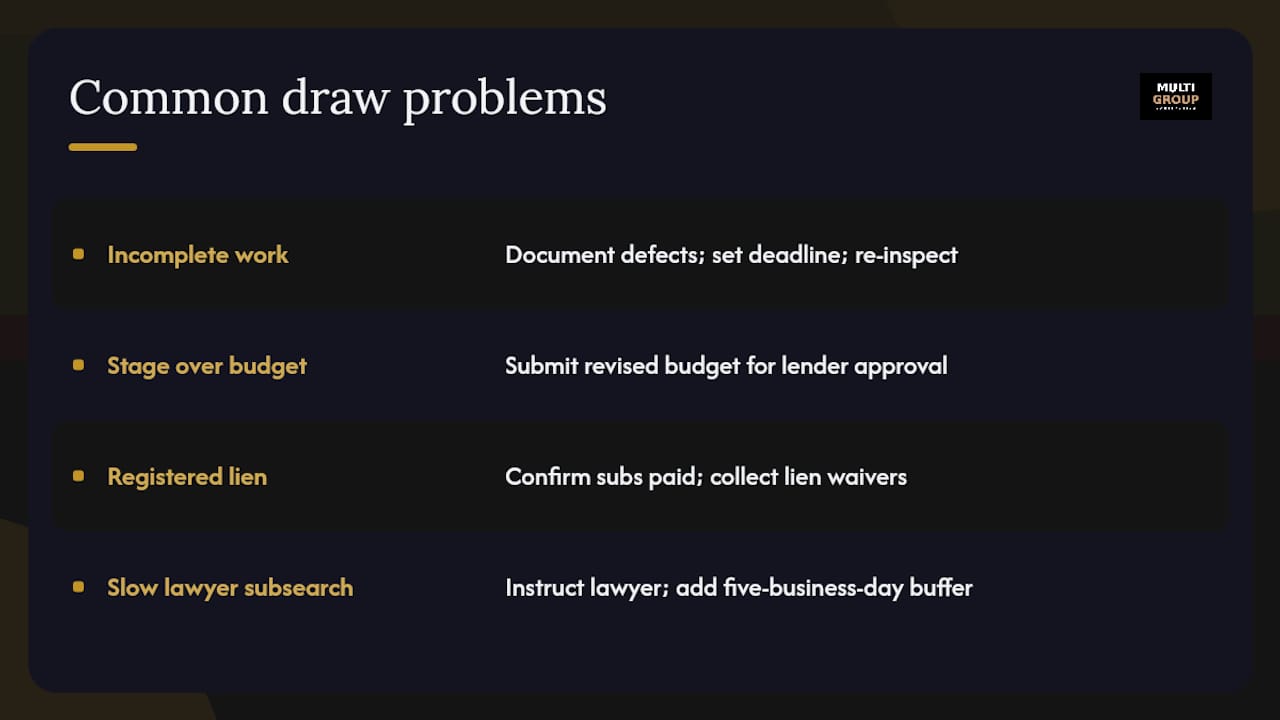
Most draw failures fall into four categories, and each has a clear resolution path if you act quickly.
1. Inspector finds incomplete or deficient work
The lender withholds the draw until deficiencies are corrected and a re-inspection is passed. Resolution: document the deficiency list in writing, set a correction deadline with the contractor, and book the re-inspection immediately. Do not wait for the contractor to self-report completion.
2. Stage is over budget
If the inspector’s cost-to-complete estimate exceeds the remaining loan balance, the lender may reduce the advance or require additional equity. Resolution: address cost overruns at the change-order stage, before the inspection, by submitting a revised budget to the lender for pre-approval.
3. Lien registered by an unpaid subcontractor
A registered lien blocks the title subsearch and stops the draw. Under the Construction Act, a payer must either pay the amount requested or issue a notice of non-payment within prescribed periods, with dispute and adjudication remedies available. Resolution: confirm with the contractor that all subcontractors have been paid before each draw request; collect lien waivers as part of the standard draw package. Understanding the difference between partial and final lien waivers helps you collect the right documentation at each stage.
4. Slow lawyer subsearch or administrative backlog
Title subsearches during busy periods can take longer than expected. Resolution: instruct your lawyer at project start, confirm their availability for each anticipated draw date, and build a five-business-day buffer into every draw cycle.
Warning: A lien registered against the property takes priority over subsequent lender advances in many provinces. If a lien is not resolved promptly, the lender may freeze all remaining draws until the matter is cleared, leaving the project without funding mid-construction.
Must-do checklist before you agree to a progress-draw mortgage
Getting the mechanics right before you sign protects your cash flow, your contractor relationship, and your project timeline. A well-structured draw process is not complicated, but it requires deliberate preparation.
Before you sign, confirm:
- The draw schedule is attached to the construction contract as a schedule, with milestone definitions specific enough to pass an inspector’s review.
- The statutory holdback percentage and release conditions are stated explicitly in the contract, consistent with your province’s legislation.
- Inspection fees and lawyer subsearch fees are accounted for in your project budget, not treated as surprises.
- Your lawyer has been briefed on the draw process and is available for each anticipated subsearch window.
- A contingency allowance of at least 10% of total project cost is included in the approved loan or held in reserve.
Useful resources for progress draws in Canada
These are the primary sources to consult when arranging construction financing or reviewing holdback obligations:
- CMHC Improvement (Mortgage Loan Insurance): CMHC’s progress advance and insured financing options for new construction and renovations, including full-service validation for up to four consecutive advances.
- Ontario Construction Act holdback rules (2026): Caravel Law’s plain-language summary of the annual holdback release requirements effective January 1, 2026.
- BC Builders Lien Act: The provincial statute governing holdback and lien rights in British Columbia; available through the BC Laws registry at bclaws.gov.bc.ca.
- RBC and Scotiabank construction mortgage pages: Both institutions publish product-specific draw counts, down payment requirements, and underwriting criteria on their public websites.
- Insight Law Firm (Ontario): Construction draw mortgage process and advantages explained from a legal perspective, including inspection and subsearch requirements.
- Falcon Lawyers: Progress draws under the Ontario Construction Act, including payment timelines and dispute remedies.
- Pushor Mitchell LLP (BC): Builders liens and the holdback explained for BC owners and contractors.
What Multigroup sees on Metro Vancouver construction projects
Working on residential and commercial builds across Metro Vancouver, the draw-timing issues Multigroup encounters most often are not caused by construction delays. They are caused by permit timing and inspection scheduling gaps that were never planned for.
Municipal permit approvals in Burnaby, Surrey, and Coquitlam can run four to twelve weeks for new residential builds, and a lender will not release the first draw until permits are in hand. When owners do not account for that window in their draw schedule, the project starts late and every subsequent milestone shifts. BC Building Code compliance inspections at framing and lock-up stages must be booked with the municipal building department, not just the lender’s inspector, and those two inspection processes do not always align. Multigroup recommends confirming both inspection tracks at project start and building a two-week buffer between the municipal inspection and the lender’s draw inspection.
Multigroup’s approach to Metro Vancouver project management includes modelling holdback timing into the project cashflow from the first planning meeting, so subcontractors are not surprised by payment timing and the project does not stall waiting for funds to clear.
Multigroup Contracting helps Metro Vancouver owners build draw-ready projects
Managing a draw-financed build in Metro Vancouver requires more than a signed mortgage. It requires a contractor who understands how lender inspections, BC Building Code compliance milestones, and municipal permit timelines interact with your funding schedule.

Multigroup Contracting works with homeowners, developers, and property managers across Metro Vancouver, including Burnaby, Richmond, Surrey, North Vancouver, and Coquitlam, on residential custom builds, tenant improvements, and commercial renovations. Every project includes permit handling, inspection coordination, and a transparent draw schedule built into the construction contract from day one. That means your lender’s inspector arrives at a site that is ready, your lawyer’s subsearch finds a clean title, and your contractor’s subcontractors are paid on time.
To discuss your project and get a draw-ready construction contract in place, contact Multigroup for a consultation.
Sources
- Construction Draw Mortgage in Ontario: Advantages & Process
- CMHC improvement (mortgage loan insurance: improvement)
- Ontario’s construction holdback rules: here’s what you need to know for 2026
- How a construction mortgage works - NerdWallet Canada
- Builders liens 101: the holdback (Pushor Mitchell LLP)
FAQ
What is a progress draw in construction?
A progress draw is a partial payment invoiced at an agreed construction milestone, with the lender releasing funds only after a third-party inspection confirms the stage is complete.
How does progress billing work in construction?
The contractor submits a draw request with supporting documents (invoice, statutory declaration, lien waivers) when a milestone is reached. The lender orders an inspection, the lawyer runs a title subsearch, and net funds are released after holdbacks and fees are deducted.
What are the typical stages of a residential construction draw schedule?
Most Canadian lenders structure draws around five stages: foundation, framing, lock-up (weathertight with rough-in complete), interior finishing, and final completion.
What is the difference between a statutory holdback and a lender holdback?
A lender holdback is a separate bank risk control, often applied to the final draw until the occupancy permit is issued. Both can apply simultaneously.
How long does a construction draw mortgage take from application to final disbursement?
A typical Canadian residential build runs six to eighteen months from permit approval to occupancy, with three to five draws over that period. Each draw cycle takes one to two weeks to process once the inspection and title subsearch are complete.