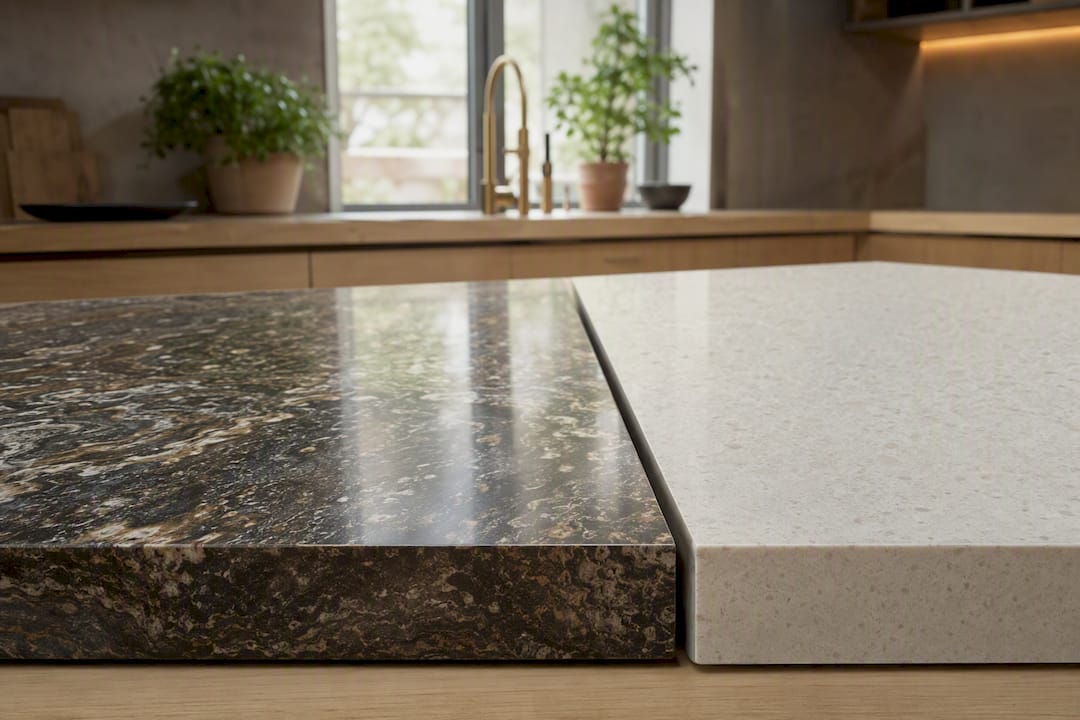
For most busy households, quartz is the better everyday choice because it never needs sealing and shrugs off stains from wine, oil, or lemon juice. Heavy cooks and anyone building an outdoor kitchen usually do better with granite, since it tolerates direct heat far better than quartz. The real trade-offs come down to four things: heat tolerance, maintenance, how much pattern variation you want, and price. The comparison table and buying checklist below break down exactly where each material wins.
TL;DR:
- Heat tolerance is crucial: granite withstands higher temperatures and outdoor UV exposure better than quartz, making it ideal for outdoor kitchens.
- Quartz’s non-porous surface resists stains like wine and oil, reducing maintenance but is vulnerable to yellowing and damage from hot pans and prolonged sun.
- Proper installation safety includes wet cutting and dust control measures, as silica dust exposure poses health hazards requiring professional management.
- Cost ranges are $50 to $100 per square foot for local granite and $55 to $140 for quartz, with long-term maintenance requirements influencing budget decisions.
- Warranty coverage differs: quartz offers limited lifetime warranties on manufacturing defects, while granite warranties focus on workmanship, not the stone itself.
Table of Contents
- Quartz vs granite countertops: a quick comparison
- What is granite, and how does it perform in a kitchen?
- What is quartz, and where does it fall short?
- How do heat, stains, scratches, and UV exposure compare?
- What should you ask before choosing a slab?
- Why installation safety matters as much as the material
- What do quartz and granite actually cost installed?
- Does your countertop choice affect resale value?
- How do warranties differ between quartz and granite?
- Quick decision guide
- Sources
- FAQ
Quartz vs granite countertops: a quick comparison
Both materials perform well in a kitchen, but they win different categories. Quartz takes durability against stains and daily wear; granite takes heat tolerance and long-term outdoor performance.
| Factor | Quartz | Granite |
|---|---|---|
| Durability | Very high, resists chipping | High, but edges can chip |
| Heat resistance | Moderate, damages above 150°C | High, tolerates hot pans |
| Stain resistance / porosity | Non-porous, no sealing needed | Porous, needs periodic sealing |
| Maintenance | Low, wipe clean | Moderate, reseal as needed |
| Appearance consistency | Very consistent, engineered pattern | Unique, varies slab to slab |
| Typical installed cost | $55 to $140/sq ft | $50 to $180/sq ft |
- Best for quartz: families who cook often, want low upkeep, and prefer a uniform look across a large island.
- Best for granite: homeowners who use heavy cast iron cookware, build outdoor kitchens, or want a one-of-a-kind natural pattern.
Granite handles direct sun and temperature swings better than quartz, which makes it the more dependable pick for an outdoor kitchen or bar counter exposed to UV year round.
What is granite, and how does it perform in a kitchen?
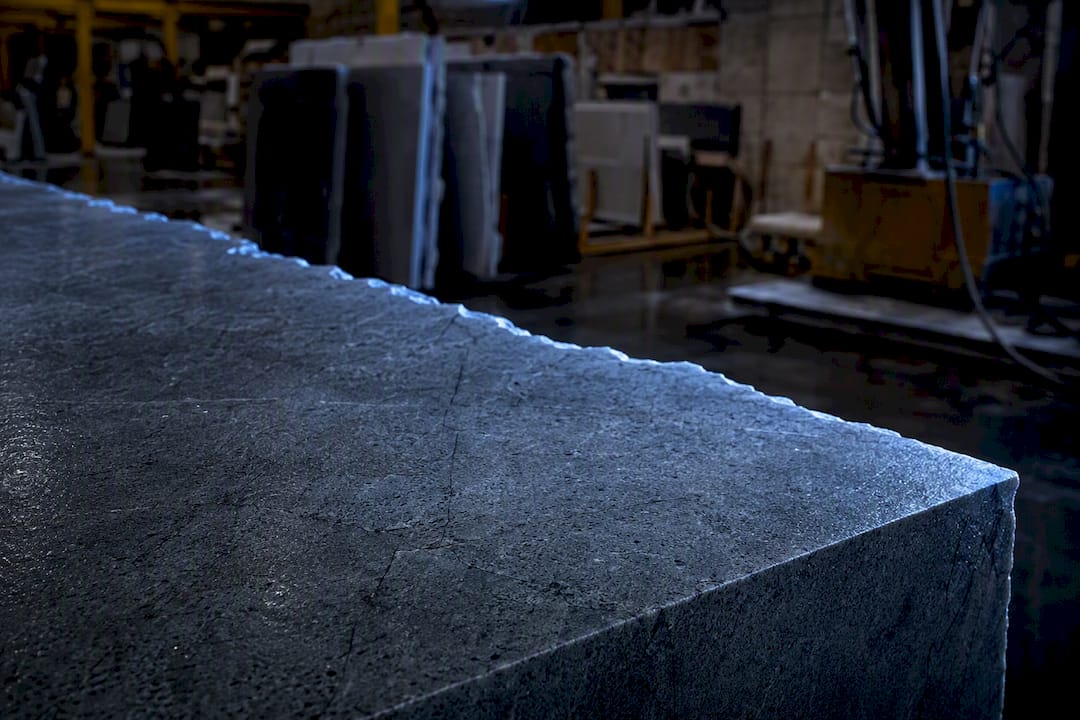
Granite is quarried igneous rock, cut into slabs, and polished. No two slabs match exactly, because mineral composition, veining, and colour depend on where the stone was cut. That variability is part of the appeal. It’s also why a slab you like in a showroom photo can look different once it arrives at your kitchen.
Real advantages: granite tolerates high heat better than nearly any countertop material, holds up for decades, shows authentic natural patterns no engineered product can replicate, and works well outdoors.
Real trade-offs:
- Porosity varies by slab density, so some granites need sealing more often than others.
- Rare colours or large slabs can be harder to source, which affects both price and lead time.
- Exact colour matching for a repair or extension years later is often impossible.
Before committing to a slab, ask your fabricator to run a water-drop test on the actual piece, not a sample chip. If water beads up rather than soaking in within a few minutes, the stone is dense enough to go longer between sealings.
Pro Tip: Walk the slab yard in person and check the edges and back of the stone for hairline cracks, especially on large islands cut from a single piece.
What is quartz, and where does it fall short?
Engineered quartz is roughly 90 to 93% ground natural quartz bound with polymer resin and pigment, pressed under vacuum into slabs. That manufacturing process is exactly why quartz behaves so differently from granite: the resin fills every pore, so the surface never absorbs liquid and never needs sealing, according to Caesarstone Canada’s care guidance.
Strengths: non-porous surfaces resist wine, coffee, and oil stains, patterns repeat consistently across slabs, and daily cleaning is just soap and water.
Limits:
- The resin component makes quartz more heat-sensitive than granite; manufacturers warn against setting hot pots directly on the surface.
- Extended sun exposure can cause yellowing over time, which rules quartz out for most outdoor applications.
- Manufacturer warranties often specify care requirements, and ignoring them can void coverage.
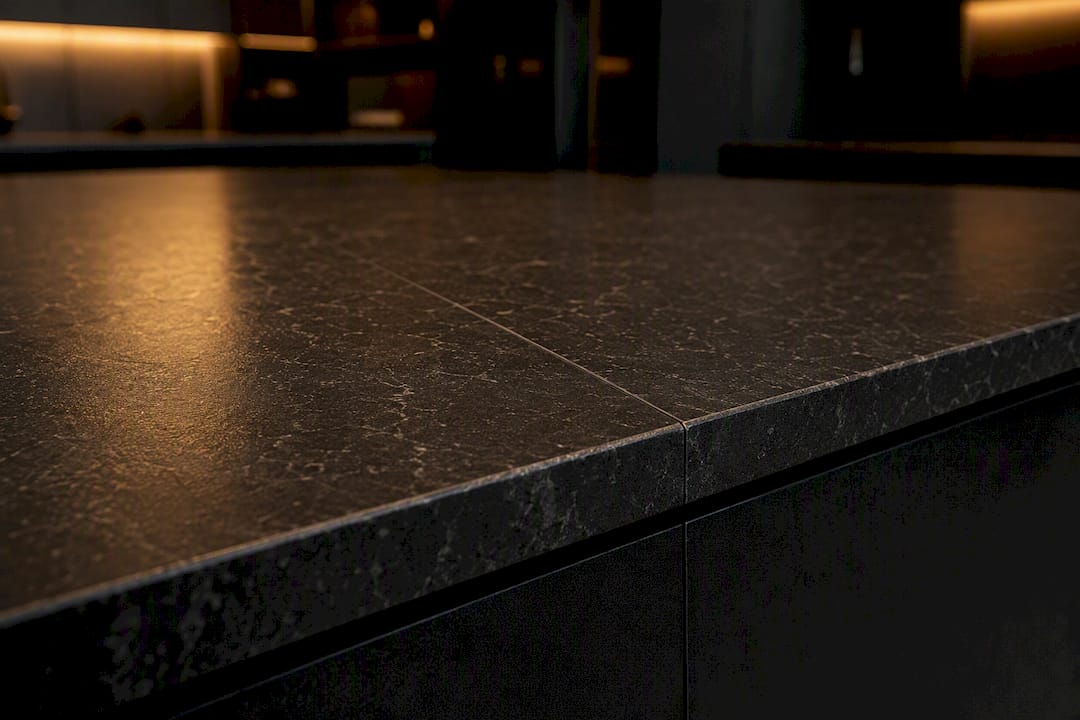
If you’re building a large island, ask your fabricator to confirm slab dimensions early. Matching veining across a seam looks far better when both pieces come from the same production batch.
Pro Tip: Request the actual slab your project will use, not a showroom sample, and check pattern continuity across where the seam will fall.
How do heat, stains, scratches, and UV exposure compare?
Heat is where the two materials diverge most. Trade testing shows quartz can begin to discolour or suffer resin damage around 150°C (about 300°F), while many granites tolerate substantially higher temperatures without visible damage. A cast iron pan straight off a stovetop burner is a real risk on quartz; on dense granite, it’s usually a non-issue.
Stain response follows a similar pattern. Quartz’s non-porous surface means spills wipe away with no absorption. Granite needs a quick wipe too, but a well-sealed slab performs nearly as well, and testing from regional fabricators shows dense granites resist oil and wine better than commonly assumed.
- Scratches: both resist knife marks, but granite chips are harder to blend invisibly than quartz resurfacing.
- Repair: quartz surface damage can sometimes be polished out; deep granite chips often need a professional epoxy fill matched to the slab colour.
- UV: granite holds its colour outdoors indefinitely; quartz resin is not designed for prolonged sun exposure.
- Lifespan: with proper care, granite commonly exceeds 50 years in service, while quartz typically performs well for 25 to 30 years before resin ageing becomes noticeable.
Use hot pads on both materials as a habit rather than an exception. It costs nothing and eliminates the single most common damage complaint fabricators hear.
What should you ask before choosing a slab?
Bring a clear usage profile to the slab yard: how often you cook with cast iron, whether you’re building an outdoor kitchen, and how large your island run needs to be.
- Ask what resin percentage the quartz uses and request the manufacturer’s heat and care sheet.
- Ask whether the granite has been sealed, with what product, and how long that sealer is rated to last.
- Confirm slab thickness matches the quote. Standard is either 2 or 3 centimetres, and mismatched thickness between slabs is a common installer shortcut.
- Request photos of the exact slab, including edges, before fabrication begins.
- Ask where the slab was quarried; local granite reduces both cost and transport emissions compared to imported exotic stone.
Red flags to walk away from:
- Vague or undocumented warranty language.
- Visible voids or hairline cracks the fabricator dismisses as “normal.”
- Reluctance to explain dust control measures during cutting.
- Pressure to sign before seeing the actual slab.
A rare imported colour often costs more for the name than the material itself. Weigh that premium against a locally quarried granite with similar veining before you commit.
Why installation safety matters as much as the material
Cutting and polishing engineered stone releases fine, silica-containing dust, and CCOHS requires employers to control that exposure with measures like wet cutting and local exhaust ventilation. This isn’t a minor fabrication detail. Silica dust exposure is a documented occupational health hazard, and provincial regulation ties directly into how a job site is run.
A licensed contractor builds these controls into every phase of the job, not just the cutting bay.
Homeowners should expect wet-cutting or HEPA-filtered dust extraction on site, proper disposal of slab offcuts, and a fabrication crew trained on silica exposure limits before a single cut is made.
- Ask your installer directly what dust control method they use.
- Confirm the crew follows BC Building Code requirements for any structural support under heavy stone.
- Verify the contractor pulls permits where the scope requires it, not just for the countertop but for any adjacent plumbing or cabinetry work.
Multigroup manages permit handling, on-site safety controls, and quality assurance across every renovation, which is exactly the kind of documented process CCOHS guidance expects from a professional crew.
What do quartz and granite actually cost installed?
Installed price depends on material grade, slab origin, and fabrication complexity, but the ranges are consistent enough to budget around.
| Material tier | Installed price (per sq ft) | Typical lifespan | Maintenance |
|---|---|---|---|
| Standard quartz | $55 to $85 | 25 to 30 years | No sealing required |
| Premium/low-carbon quartz | $90 to $140 | 25 to 30 years | No sealing required |
| Local granite | $50 to $100 | 50+ years | Reseal every few years, denser slabs less often |
| Exotic/imported granite | $130 to $180 | 50+ years | Reseal every few years, denser slabs less often |
These bands come from current Canadian pricing data. Local granite generally costs less than imported stone once freight is factored in, and sourcing closer to home cuts transportation emissions too.
Does your countertop choice affect resale value?
Both materials read as premium upgrades to buyers and appraisers, but they signal slightly different things. Granite has a long track record as the traditional benchmark for a high-end kitchen, and buyers who grew up seeing granite in aspirational homes still associate it with quality. Quartz has caught up quickly in buyer preference, particularly among younger homeowners who value low maintenance over natural variation, according to Home Depot’s comparison of the two materials.
In practice, neither material consistently outperforms the other on resale. What matters more is condition and consistency with the rest of the kitchen. A chipped, unsealed granite counter with visible etching drags down a listing’s impression regardless of the stone’s original price tag. A quartz counter that still looks new after a decade reads as low-risk to a buyer who doesn’t want to inherit a maintenance routine.
If you’re renovating with resale in mind rather than personal use, lean toward whichever material matches your neighbourhood’s dominant kitchen style. In markets with a lot of older character homes, natural granite or even granite-look quartz tends to feel appropriate. In newer condo and townhouse developments across Metro Vancouver, buyers increasingly expect the clean, uniform look quartz delivers.
One point worth remembering: a countertop rarely sells a home on its own, but a countertop showing damage or heavy staining will actively work against you during showings. Budget for the material that fits how you actually live, not the one you think a future buyer might prefer. If you’re weighing countertop upgrades against other renovation priorities, our kitchen renovation guide for Metro Vancouver homeowners covers where countertop spending typically ranks against cabinetry and layout changes.
How do warranties differ between quartz and granite?
Warranty coverage is one of the clearest practical differences between the two materials, and it’s often overlooked until something goes wrong. Quartz manufacturers typically offer warranties ranging from 10 years to a limited lifetime warranty, covering manufacturing defects like cracking, staining, or discolouration under normal use. That coverage usually comes with conditions: using cutting boards, avoiding direct heat, and following the manufacturer’s specific care instructions. Violate those terms, and the warranty can be voided even if the damage looks accidental.
Granite, being a natural material rather than a manufactured product, doesn’t come with the same kind of manufacturer warranty. Instead, coverage typically comes from the fabricator or installer and focuses on workmanship: seam quality, edge finishing, and installation integrity, usually for one to five years. The stone itself isn’t “warrantied” against natural characteristics like fissures or mineral variation, because those are inherent to the material, not defects.
This distinction matters when you’re comparing quotes. A quartz warranty that sounds generous on paper may exclude common kitchen behaviours like setting down a hot pan without a trivet. A granite installer’s workmanship warranty won’t cover you if the stone itself was porous and improperly sealed before installation, which is why asking about sealer type and warranty period at the point of purchase matters more than the length of the paper warranty itself.
Always get warranty terms in writing before signing a contract, and ask specifically what voids coverage. A reputable contractor will explain this without hesitation.
Quick decision guide
- Busy households and families: quartz’s non-porous surface means fewer maintenance tasks and less worry about permanent stains.
- Heavy cooks and outdoor kitchens: granite’s heat tolerance makes it the safer long-term choice near stovetops and grills.
- Budget planning: factor installation and long-term maintenance into your total cost, not just the per-square-foot slab price.
- Safety: hire a licensed installer who follows documented silica dust controls during cutting and fabrication.
| Priority | Recommended material |
|---|---|
| Low maintenance | Quartz |
| High heat tolerance | Granite |
| Outdoor use | Granite |
| Uniform, engineered look | Quartz |
A contractor’s view on choosing between quartz and granite
Most homeowners we work with already lean one way before they call us, and the comparison above usually confirms it. Where Multigroup adds value is matching that preference to the realities of the space: load-bearing considerations for heavy stone, seam placement on large islands, and permit requirements under the BC Building Code when a renovation touches plumbing or structural support. Getting that sequencing right the first time avoids costly rework later.
— MultigroupTeam
Get a quote for your countertop and kitchen renovation
Choosing between quartz and granite is only part of a kitchen renovation. Getting it installed correctly, on a permit-compliant schedule, with a licensed Vancouver general contractor is what actually protects your investment.

Multigroup handles the full scope of residential and commercial renovation work across Metro Vancouver, from countertop and cabinetry installation to full kitchen rebuilds, permit handling, and project management from start to finish. Whether you’re a homeowner planning a residential upgrade or a business owner working through a commercial renovation in Vancouver, our crews coordinate fabrication, plumbing, and electrical work under one schedule instead of juggling separate trades yourself. CAD pricing varies by scope and slab selection, but most kitchen counter installations fold into a broader renovation quote within days of a site visit. If your restaurant or coffee shop kitchen needs commercial-grade surfaces that meet code and hold up under daily volume, our restaurant and coffee shop renovation team can walk you through material options during your first consultation. Request a quote through Multigroup and get a project timeline before you commit to a slab.
Sources
- Reno Quotes — Quartz vs Granite Countertops in Canada 2026
- Caesarstone Canada — Quartz countertops: comprehensive guide
- Alpine Countertops — Quartz vs granite for Vancouver kitchens
FAQ
What is better, quartz or granite?
Neither wins outright. Quartz suits low-maintenance households best, while granite suits heavy cooks and outdoor kitchens thanks to its higher heat tolerance.
Can you put a hot cup of tea on quartz?
A hot mug is generally fine, but manufacturer guidance warns against setting very hot pots or pans directly on quartz, since the resin component can discolour or weaken with prolonged heat exposure.
Which is more expensive, quartz or granite?
Standard quartz runs $55 to $85 per square foot installed, while local granite starts lower at $50 per square foot; exotic granite and premium quartz both climb toward $140 to $180 per square foot depending on rarity and finish.
Why is quartz on the decline?
Quartz isn’t in broad decline, but some homeowners are moving away from it due to heat sensitivity and possible UV yellowing outdoors, along with growing interest in the natural variation granite offers.
Is quartz better than granite for resale value?
Neither consistently outperforms the other on resale; buyer preference tends to follow neighbourhood style, with quartz favoured in newer developments and granite still associated with traditional high-end kitchens.