
Scope creep in construction is the uncontrolled addition of work beyond the contracted baseline — changes that enter the project without a formal written change order, a revised schedule, or an agreed price. Left unchecked, it erodes margin, extends timelines, and creates the conditions for serious contractual disputes. If you suspect it is already happening on your project, take three steps right now:
- Stop the work in question until the change is documented. Continuing without written direction can be treated as acceptance.
- Document the request in writing — a dated email, a site diary entry, or a formal Request for Information (RFI) that records who asked, what was requested, and when.
- Issue a provisional direction or quotation request to the owner or consultant, confirming you are proceeding under protest or pending formal approval.
Pro Tip: When an owner or consultant gives a verbal instruction on-site, respond the same day in writing: “We acknowledge your direction to [describe change]. We will proceed pending receipt of a formal change order. Our right to recover additional cost and time is expressly reserved.” That single sentence preserves your contractual entitlement.
Key takeaways
Scope creep in construction is preventable when teams enforce a written change-order process, maintain a single change register, and complete front-end planning before mobilisation.
| Point | Details |
|---|---|
| Scope creep is a contract risk | Change in scope affected a substantial share of Canadian projects and drove contentious costs averaging a significant portion of CAPEX. |
| Front-end planning is the primary defence | A firm SOW, a WBS with named owners, and fully coordinated drawings prevent most scope changes before mobilisation. |
| Written change orders are non-negotiable | Proceeding on verbal instructions risks waiving contractual protections and complicates cost recovery under Canadian law. |
| Use a single change register | One master log with sequential numbers, dates, and approval status is the foundation of any successful claim or defence. |
| Multigroup enforces these controls | Multigroup’s pre-mobilisation checklist and 5–7 business day quotation SLA protect budget and schedule on Metro Vancouver TI and retail buildout projects. |
Table of Contents
- What does scope creep look like on a construction site?
- What causes scope creep in construction projects?
- How does scope creep affect cost, schedule, and disputes?
- How to prevent scope creep: controls before and during construction
- What is the change-order process, step by step?
- What documents and tools do you need to track scope changes?
- What are the legal and contract risks in BC and Canada?
- How Multigroup prevents scope creep on Vancouver projects
- How Multigroup helps you control scope on your next project
- A note from the Multigroup team on scope creep in practice
- Sources
- FAQ
What does scope creep look like on a construction site?
Scope creep rarely announces itself. It tends to arrive as a small favour, a quick clarification, or a “while you’re here” request from an owner who assumes the work is already included. Recognising it early is the first line of defence.
Common site-level signs:
- Verbal instructions from an owner, consultant, or property manager that are not followed by a written change order
- Design details that shift between drawing revisions without a formal revision notice or delta cloud
- “Minor” additions to finishes, fixtures, or layouts during a tenant improvement or retail buildout that were not in the original scope of work
- Requests to extend operating hours, accelerate a trade, or re-sequence work without a schedule amendment
- A rising RFI count in the last third of a project, which often signals that the drawings were never fully coordinated
How to classify a change correctly:
A change is a new deliverable when it requires labour, materials, or time not contemplated in the contract documents. It is an interpretation of existing scope only when the contract drawings and specifications, read together, clearly describe the work. When there is genuine ambiguity, treat it as a potential change and issue an RFI. Waiting to see whether the owner will pay for it later is how disputes start.
Site supervisors should track RFI frequency, the number of informal instructions logged in daily diaries, and the running count of change orders issued. A spike in any of these three metrics is an early warning that scope is drifting.
What causes scope creep in construction projects?
Scope creep rarely has a single cause. It is almost always the product of several compounding failures, most of which are preventable at the front end of a project.
- Incomplete or late design documentation. Drawings issued for tender that are missing details, contain conflicts between disciplines, or arrive after mobilisation force contractors to make assumptions. Incomplete or incorrect design documentation is a primary driver of scope changes in Canadian capital projects.
- Owner indecision or late-stage changes. Owners who have not fully committed to a programme before construction begins tend to request substitutions, layout changes, and finish upgrades after work has started, when the cost of change is highest.
- Multiple oversight entities. Projects with joint-venture ownership, strata councils, or multiple consultants reviewing the same work generate conflicting instructions. Academic research identifies the number of oversight entities and communication quality among owner parties as top scope creep indicators.
- Poor RFI discipline. When RFIs are answered verbally, answered late, or answered with a scope expansion that is never priced, the contractor absorbs the cost by default.
- Vague or absent scope of work (SOW). A contract that describes work in general terms rather than by reference to specific drawings, specifications, and a defined scope of work leaves every ambiguity open to dispute.
- No Work Breakdown Structure (WBS). Without a WBS that assigns named owners to discrete deliverables, it is impossible to tell whether a new task falls inside or outside the contracted scope.
Statistic callout: A CRUX/HKA analysis of Canadian projects found that design-related factors — incorrect, incomplete, and late-issued documents — were frequently entangled with scope change, with design-related failures affecting 44.8% of projects in some categories, compounding disputes and cost overruns.
Front-end planning failures are the systemic root. When a project mobilises without a firm SOW, a complete WBS, and fully coordinated drawings, scope creep is not a risk — it is a near certainty.
How does scope creep affect cost, schedule, and disputes?
The financial and schedule consequences of uncontrolled scope change are well documented in Canadian data, and they are substantial.
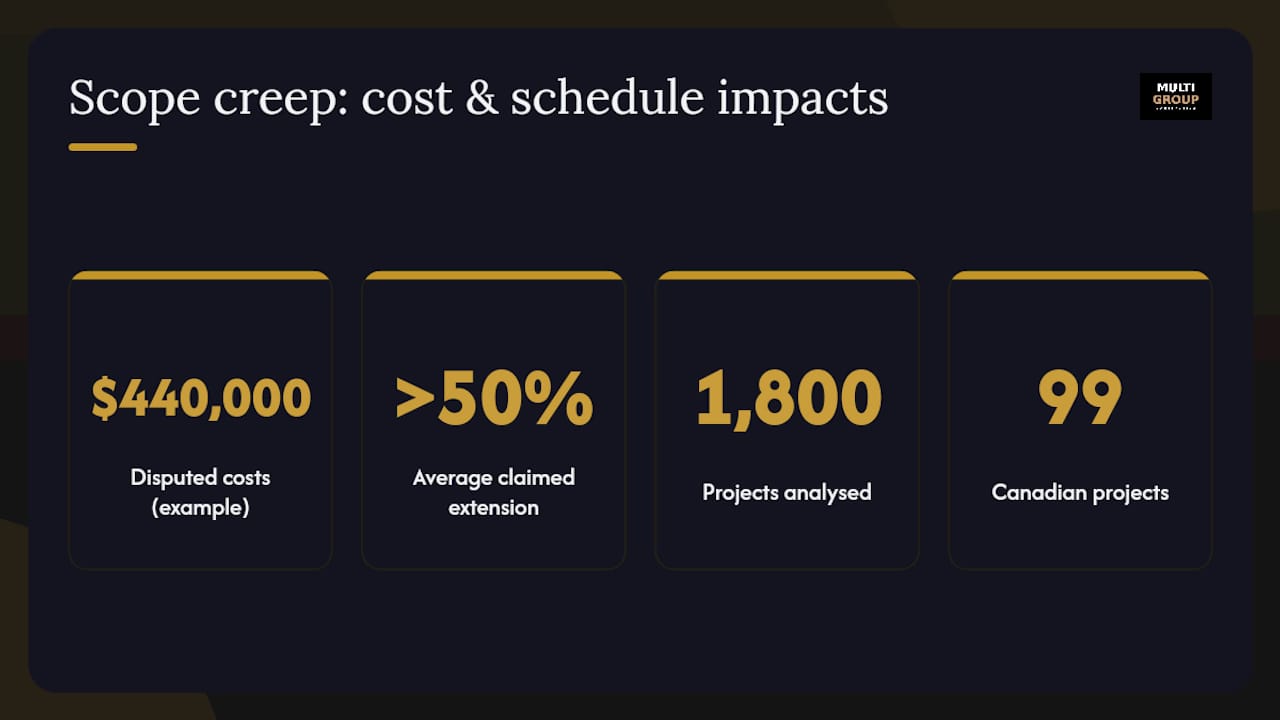
CRUX/HKA’s analysis of Canadian construction projects found that change in scope was the leading cause of disputes, affecting a substantial share of projects. Contentious costs averaged a significant portion of CAPEX, and claimed time extensions averaged over half of the planned project duration. That means a project budgeted at $2 million CAD could face $440,000 in disputed costs, and a 12-month schedule could carry a six-month extension claim.
The mechanism is straightforward. Each informal change adds labour and materials that were not priced into the contract. Trades are pulled off their planned sequence, creating idle time and re-mobilisation costs. When the contractor finally submits a change-order package, the owner disputes the connection between the change and the cost, because nothing was documented at the time the work was done.
A realistic scenario: A retail tenant improvement in Burnaby includes a verbal instruction from the property manager to relocate two electrical panels — a “quick” change that takes two days. No change order is issued. The electrician’s re-sequencing delays the drywall crew by three days. The project finishes late, the tenant misses their opening date, and the contractor submits a delay claim. The owner refuses to pay, arguing the panel relocation was included in the original scope. Without a dated, written record of the instruction and its impact, the contractor’s recovery is uncertain.
The HKA/CRUX global dataset covered more than 1,800 projects across 106 countries, including 99 in Canada, and concluded that the majority of these cost and schedule overruns are avoidable with predictable controls. The data makes a compelling case for investing in prevention.
How to prevent scope creep: controls before and during construction
Prevention is a two-phase effort: what you lock down before mobilisation, and what you enforce daily on-site.
Pre-construction checklist
- Finalise and sign the scope of work before any work begins; every item must reference a specific drawing number and specification section.
- Build a WBS with named owners for every deliverable. Assign responsibility at the trade level, not just the division level.
- Confirm all drawings are fully coordinated across architectural, structural, mechanical, and electrical disciplines. Flag any outstanding RFIs before the contract is executed.
- Identify long-lead equipment and confirm procurement dates. Late equipment deliveries are a common trigger for scope substitutions.
- Define allowance and contingency rules in writing: who authorises drawdowns, what triggers a formal change order, and what the approval threshold is.
- Hold a pre-construction alignment meeting with all subcontractors, the owner, and the consultant team. Front-end planning and partnering are among the highest-impact mitigations identified in academic research on scope change.
During-construction controls
- Require all instructions to be in writing before work proceeds. No verbal directions, no exceptions.
- Maintain daily site diaries that log weather, crew counts, visitors, and any instructions received.
- Use a single change-order intake log. Every potential change gets a number the day it is identified, regardless of whether it is ultimately approved.
- Establish a clear authority matrix: who can approve minor field adjustments (superintendent level, up to $500 CAD), who approves change orders (project manager, up to $10,000 CAD), and who approves anything above that threshold (owner’s representative or executive).
- When a supervisor is pressured to proceed without a change order, use this script: “We are happy to proceed. We will need a written direction from you today and will follow up with a formal change-order quotation within five business days.”
Pro Tip: When quoting a change, add this qualification: “This price covers known conditions only, based on information available at [date]. Cumulative impact costs and any schedule extension entitlement are expressly reserved.” It takes one sentence to protect months of potential recovery.
For construction risk management in BC, this authority matrix and qualification language should be embedded in your subcontract templates, not just your prime contract.
What is the change-order process, step by step?
A disciplined change-order workflow is the single most effective tool for controlling scope drift. Here is the process Multigroup and other licensed BC contractors use.
- Identification. A potential change is identified by any party — owner, consultant, superintendent, or subcontractor. It is logged immediately in the change register with a unique number, date, and originator.
- RFI or notification. The contractor issues a written RFI or change notice to the consultant, confirming the potential change and requesting clarification or a formal direction.
- Provisional direction. If the owner or consultant wants work to proceed before pricing is complete, they issue a provisional direction in writing. The contractor confirms receipt and notes that cost and time impacts are reserved.
- Contractor quotation. The contractor prepares a detailed quotation within a few business days for straightforward changes. Complex changes with subcontractor pricing may require up to several calendar days. Industry association guidance supports defined turnaround windows to prevent frozen costs and schedule drift.
- Owner review and approval. The owner reviews the quotation and responds within an agreed window (typically 7–14 days). If the owner rejects the quotation, the contractor may issue a stop-work notice for that scope item.
- Execution. Once the change order is signed by both parties, work proceeds. The change is added to the contract sum and the baseline schedule is updated.
- Close-out. The signed change order is filed, the change register is updated to “approved,” and the cost and schedule impacts are reflected in the next progress billing.
Change register fields
| Field | Purpose |
|---|---|
| Change number | Unique sequential identifier |
| Date identified | When the potential change was first logged |
| Originator | Owner, consultant, contractor, or subcontractor |
| RFI or DR number | Cross-reference to the formal document |
| Description | Plain-language summary of the work |
| Estimated cost (CAD) | Contractor’s preliminary estimate |
| Time impact (days) | Estimated schedule extension |
| Quotation reference | Change-order quotation document number |
| Approval status | Pending, approved, rejected, or disputed |
| Authorised sign-offs | Owner and contractor representative signatures |
When an owner refuses to issue a provisional direction and insists on proceeding verbally, the contractor’s safest response is to stop work on that item, document the refusal in writing, and escalate to the project manager. Proceeding without written direction is how contractors lose entitlement.
What documents and tools do you need to track scope changes?
Controlling scope creep is a documentation discipline as much as a management one. The following records are the minimum required to protect your position on any Canadian construction project.
- Signed contract and scope of work — the baseline against which every change is measured
- Baseline schedule — the original programme, preserved as a snapshot before any changes are applied
- WBS — the deliverable breakdown that defines what is and is not in scope
- RFI log — every question, the date issued, the date answered, and the answer itself
- Daily site diaries — signed by the superintendent, dated, and stored in a cloud-accessible location
- Change register — the master log of all potential, pending, and approved changes (fields listed above)
- Change-order attachments — the signed change order, the supporting quotation, and any drawings or specifications that define the changed work
- Dated email and correspondence trail — every instruction, direction, and approval, preserved in chronological order
- Site photographs — dated and geotagged, taken before, during, and after any changed work
- Submittal and manufacturer revision log — tracks when product substitutions are introduced, which often signals a scope change
For software, Canadian project teams commonly use Procore, Buildertrend, or Fieldwire for document control and RFI tracking. All three support cloud storage, audit trails, and mobile access for site supervisors. For smaller projects, a shared SharePoint folder with a locked baseline schedule and a single Excel change register is sufficient — provided the folder structure is consistent and access is controlled.
Pro Tip: Designate one person as the single source of truth for the change register. When two people maintain separate logs, versions diverge and disputes become harder to resolve.
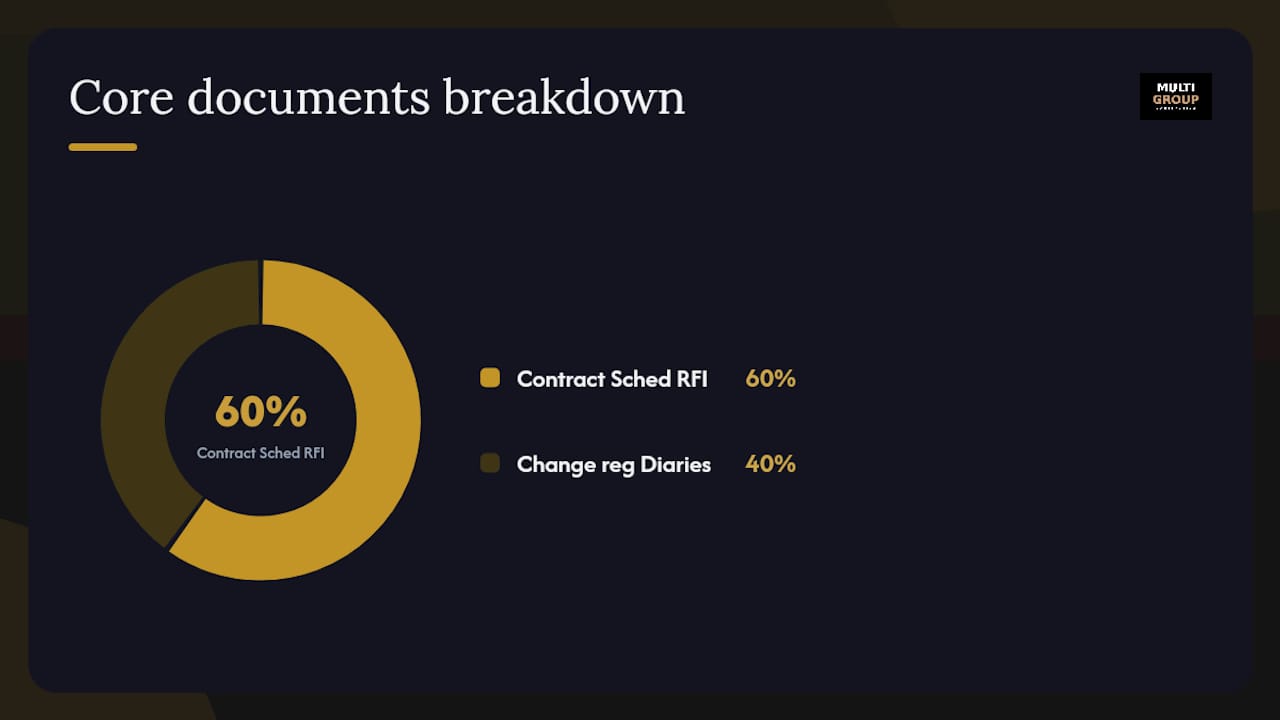
The must-have construction documents for Canadian projects include the signed contract, the baseline schedule, and the RFI log as the three non-negotiables. Add the change register and daily diaries, and you have the core package needed to support any claim or defence.
What are the legal and contract risks in BC and Canada?
Scope creep carries specific legal risks under Canadian construction law, and BC projects face additional considerations tied to the BC Building Code and permit requirements.
Key legal risks to watch:
- Waiver by conduct. Allowing work to proceed on verbal instructions, or accepting payment for changed work without a written change order, can be interpreted by BC adjudicators and courts as a waiver of your contractual change procedure. Once waived, recovering the full cost of extras becomes significantly harder.
- Unclear change procedures. Contracts that do not specify a change-order process, a notice period, or an approval authority create ambiguity that benefits neither party. Construction-law guidance is clear that formal written change orders are legally distinct from informal scope creep, and that proceeding on verbal instructions complicates cost recovery.
- Improper invoice timing. Submitting a change-order invoice months after the work was done, without contemporaneous documentation, weakens the claim and may trigger a dispute over whether the work was ever directed.
- Lien and prompt-payment implications. In BC, the Builders Lien Act requires contractors to preserve lien rights within strict timelines. Undocumented scope changes that inflate the contract value without a signed change order can complicate lien calculations. Where prompt-payment and adjudication regimes apply, a documented change register and signed change orders are the fastest path to payment resolution.
- Adjudication. BC’s construction adjudication framework provides a practical, time-limited pathway to resolve payment disputes, including disputed change orders, without full litigation. A complete paper trail is the foundation of any successful adjudication.
BC Building Code and permit amendments
Not every scope change is purely contractual. Changes that affect the building envelope, structural elements, fire separations, mechanical systems, or occupancy classification under the BC Building Code may require a permit amendment before work proceeds. Proceeding without an amended permit exposes the owner to stop-work orders and the contractor to liability for non-compliant work.
When a scope change triggers a permit amendment, add the permit review timeline to the change-order schedule impact. In Metro Vancouver, permit amendments for commercial tenant improvements typically take 2–6 weeks depending on the municipality and the complexity of the change.
Pro Tip: If an owner instructs you to proceed with a change that you believe requires a permit amendment, document your concern in writing immediately: “We note this change may require a permit amendment under the BC Building Code. We will proceed only after confirmation from the Authority Having Jurisdiction (AHJ) or written direction from the owner accepting responsibility for any non-compliance.” That sentence protects you from liability for the owner’s decision.
How Multigroup prevents scope creep on Vancouver projects
Multigroup applies a structured pre-mobilisation and site-management process on every commercial project in Metro Vancouver, whether it is a tenant improvement in Burnaby, a retail buildout in Richmond, or a warehouse renovation in Surrey.
Pre-mobilisation checklist Multigroup uses:
- SOW finalisation meeting with the owner and consultant before any trade is engaged
- WBS assignment with named trade owners for every deliverable, reviewed at the kick-off meeting
- Milestone approval schedule issued to the owner, with sign-off required before each phase begins
- Long-lead equipment confirmation: items with lead times over four weeks are confirmed on purchase order before mobilisation
- Subcontractor alignment meeting covering scope interfaces, RFI protocols, and change-order submission requirements
KPIs and SLAs Multigroup tracks:
- Initial change-order quotation: typically several business days from written direction
- Full cost validation for complex changes: 21 calendar days
- RFI closure target: a few business days for consultant response
- Change-order approval SLA: about ten business days from quotation submission
For Metro Vancouver tenant improvement projects, typical high-level CAD cost ranges for common scope-change items include: electrical panel relocation ($3,500–$8,000 CAD), demising wall addition ($4,000–$12,000 CAD per linear metre of partition, depending on fire-rating requirements), and HVAC zone addition ($6,000–$15,000 CAD). These figures are indicative; actual costs depend on building conditions, permit requirements, and trade availability.
Multigroup coordinates directly with Metro Vancouver municipalities on permit amendments, BC Building Code compliance reviews, and AHJ pre-application meetings, reducing the schedule risk that permit-related scope changes create.
How Multigroup helps you control scope on your next project
Scope creep in construction is manageable when you have the right process, the right documentation, and a general contractor who enforces both from day one. Multigroup brings that discipline to every tenant improvement and retail buildout in Metro Vancouver, from the first SOW review through to final permit sign-off.

Every Multigroup project starts with a locked scope of work, a WBS with named trade owners, and a change-order workflow that protects your budget and your schedule. Permit coordination, BC Building Code compliance, and subcontractor alignment are built into the process, not added as afterthoughts. If you are planning a tenant improvement, retail fit-out, or commercial renovation in Burnaby, Richmond, Surrey, or anywhere across Metro Vancouver, contact Multigroup for a free scope review and project quote at Multigroup.
A note from the Multigroup team on scope creep in practice
The projects where scope creep does the most damage are rarely the large, complex ones. They tend to be mid-size tenant improvements or retail buildouts where the owner is engaged, enthusiastic, and making decisions quickly — often verbally, often on-site. The controls described in this article are not bureaucratic obstacles. They are the tools that keep a good working relationship from turning into a payment dispute six months after completion. At Multigroup, we apply these controls on every Metro Vancouver project because protecting the client’s budget and schedule is the same thing as protecting our own reputation. If you are about to start a commercial renovation and want to review your scope controls before mobilisation, reach out through Multigroup.
Sources
- Canada better than average in avoiding construction claims and disputes
- Identifying Manageable Scope Creep Indicators and Selecting Best Practice Strategies for Construction Projects
- Getting to the crux of time and cost overruns on capital projects
- MCAMB
FAQ
What is scope creep in construction?
Scope creep in construction is the uncontrolled addition of work beyond the contracted baseline, typically through verbal instructions or informal requests that are never formalised in a written change order.
Who is responsible for managing scope creep?
The general contractor is responsible for identifying and documenting potential scope changes, but the owner holds authority to approve or reject them. A clear authority matrix defining approval thresholds for each party is the most effective governance tool.
What are the downsides of scope creep?
Uncontrolled scope change drives cost overruns, schedule delays, and contractual disputes. CRUX/HKA data shows contentious costs on Canadian projects average about 22% of CAPEX and claimed time extensions average 53.4% of planned duration.
What is a well-known example of scope creep in construction?
A common example is a tenant improvement where the owner verbally requests additional electrical outlets, a relocated partition wall, and upgraded flooring finishes during construction. Each change seems minor, but together they add weeks to the schedule and tens of thousands of dollars in unpriced labour and materials.
How do written change orders protect contractors in Canada?
Written change orders create a documented record of agreed scope, price, and schedule impact. Without them, proceeding on verbal instructions can be treated as a waiver of contractual protections, making cost recovery significantly harder under Canadian construction law.