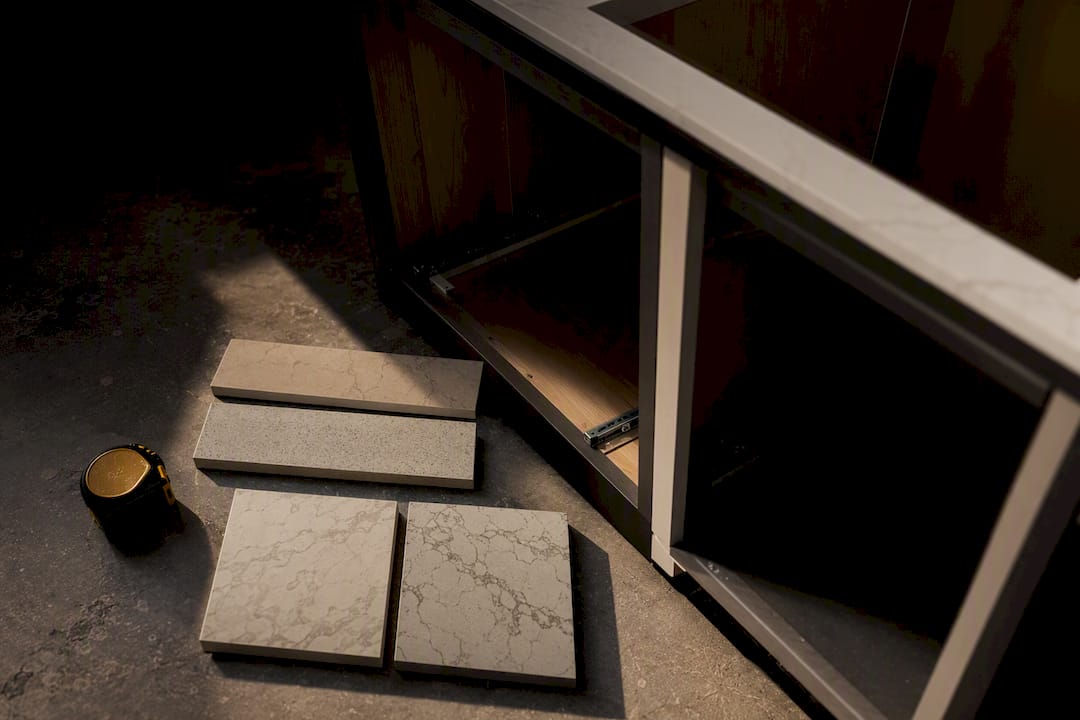
Silestone tends to win on design range and bold, high-contrast patterns; Caesarstone tends to win on architectural neutrals and marble-look consistency across large runs. Day-to-day performance between the two is close enough that it rarely decides the outcome. What actually decides it, most of the time, is the fabricator. Confirm slab batches in person and vet installer references before you commit either brand to a job.
TL;DR:
- Proper slab batch verification and careful installer selection can prevent common issues like seam separation and edge chipping, which are more often caused by handling than material quality.
- Full slab viewing is essential before purchase, as small samples can mislead with pattern repetition and slab-to-slab variation, especially for large spaces or continuous runs.
- Both brands perform similarly in resistance to everyday stains and scratches when installed with correct sealing and maintenance, but extreme heat or poor fabrication can cause damage regardless of brand.
- Price differences are driven more by collection choice, slab size, and edge details than brand name, making budget considerations crucial when selecting a material.
- For commercial or multi-unit projects, avoiding mismatched or poorly fabricated quartz, rather than brand preference, is the key to maximizing resale value and long-term durability.
Table of Contents
- Caesarstone vs Silestone: quick comparison for common priorities
- What Caesarstone and Silestone actually have in common
- Design differences: how Caesarstone and Silestone actually look
- How durable is quartz, and where does it actually fail?
- What drives cost and how long will you wait for material?
- Fabrication and installation: what to require from your installer
- Which brand fits your renovation, and a showroom checklist
- The final call on Caesarstone vs Silestone
- Does countertop brand affect resale value?
- Coordinating countertop selection on real projects
- How Multigroup manages the finishes that make or break a renovation
- Sources
- FAQ
Caesarstone vs Silestone: quick comparison for common priorities
Buyers rarely ask “which brand is objectively better.” They ask which brand solves their specific problem, so here’s how the two stack up against the priorities we hear most often on commercial and residential projects alike.
- Want bold pattern variety or a statement slab? Silestone’s catalogue leans harder into high-contrast veining and saturated colour options.
- Want a consistent, marble-look neutral across a long run of units? Caesarstone’s architectural collections are built for that kind of repeatability.
- Prioritizing stain resistance in a high-traffic food or clinical setting? Both brands market strong stain performance, and independent manufacturer FAQ guidance confirms both hold up well against everyday spills when installed and sealed correctly at the seams.
- Need to match a spec across multiple units or floors? Look at batch consistency and how many suppliers stock that exact colourway locally, not just the brand name.
- Working with a tight budget? Price bands vary more by collection and slab size than by brand. Entry-level lines from either manufacturer land in similar territory; premium or design-forward collections cost more regardless of which name is on the invoice.
Availability also swings by collection. A popular Caesarstone architectural neutral might sit in local stock, while a limited-run Silestone pattern could mean a longer lead time. None of that matters much, though, if the fabricator handling the templating and installation cuts corners. That’s the variable that determines whether either brand performs the way its marketing promises.
What Caesarstone and Silestone actually have in common
Before comparing differences, it helps to know what you’re not choosing between. Both are engineered quartz surfaces, meaning crushed natural quartz bound with resins and pigments under pressure, not solid quarried stone. That manufacturing process is what gives both brands their core properties.
Both land around a Mohs hardness of 7, both produce a non-porous surface that never needs sealing, and both resist the stains that ruin natural stone counters: wine, coffee, citrus, cooking oil. Caesarstone’s own FAQ confirms this baseline directly, and it applies equally to Silestone’s engineered lines.
Maintenance is nearly identical for both:
- Wipe with warm water and mild soap; avoid abrasive pads that dull the finish.
- Use a cutting board. Quartz resists scratches but isn’t scratch-proof.
- Keep hot pans off the surface directly. Engineered quartz is sensitive to extreme heat and prolonged UV exposure, and manufacturers recommend indoor use for that reason.
- Skip harsh chemicals like bleach, oven cleaner, or paint stripper on the surface.
The failures that actually show up on job sites, edge chipping, seam separation, cloudy resin from heat exposure, trace back to fabrication and handling far more often than to the brand printed on the slab.
Design differences: how Caesarstone and Silestone actually look
This is where the two brands genuinely diverge, and it’s usually the deciding factor for homeowners who care about aesthetics as much as function.
- Pattern range and boldness. Silestone’s collections skew toward dramatic veining, deep colour saturation, and statement-slab options designed to be a room’s focal point. If you want a kitchen island that reads as a design centrepiece rather than a background surface, Silestone’s palette gives you more to work with.
- Architectural neutrals and marble-look consistency. Caesarstone built its reputation on clean, quiet marble-look ranges and neutral tones that work across an entire building without competing for attention. That consistency is exactly why specifiers on multi-unit and commercial projects often default to it: manufactured quartz delivers a predictable, uniform appearance that natural stone can’t guarantee slab to slab.
- Finish and texture options. Both brands offer polished, honed (matte), and textured finishes. Honed finishes photograph beautifully in listing photos and design portfolios but show fingerprints and light etching more readily in daily use than polished surfaces do. A finish that looks perfect in a catalogue photo can behave differently under your kitchen’s actual lighting and traffic.
- How brand ecosystems affect multi-surface projects. Both manufacturers produce broader surfacing lines beyond kitchen counters, including bathroom vanities, wall cladding, and flooring in some collections. If a project calls for matched materials across multiple surfaces, staying within one brand’s ecosystem often simplifies colour matching and batch tracking more than mixing manufacturers.
None of this settles the debate on its own. A showroom sample the size of a dinner plate tells you almost nothing about how a full slab reads in your kitchen’s light. Small samples routinely mislead buyers because slab patterns repeat and vary in ways a swatch can’t show. Insist on viewing full slabs, ideally more than one from the same batch, before signing off on either brand.
How durable is quartz, and where does it actually fail?
Manufacturer claims on stain and impact resistance hold up well in ordinary kitchen and bathroom use for both brands. The gap between marketing and reality shows up at the extremes: sustained heat exposure, direct sun through a large window, and poor installation technique.
Pro Tip: Keep a trivet by every stove, always. Heat damage to resin is one of the hardest quartz problems to reverse, and prevention costs nothing.
The most common damage modes, in order of how often they actually happen:
- Edge chips, usually from a dropped pot or heavy cookware hitting a mitred edge at an angle.
- Heat marks or resin discolouration, from hot pans, slow cookers, or appliances left running directly on the surface.
- Seam separation, almost always traced back to inadequate support or the wrong adhesive during installation rather than a material defect.
Most of these failures are preventable with correct fabrication technique, proper adhesive selection, and adequate clamping during cure time. That’s true regardless of whether the slab says Caesarstone or Silestone on the label.
One figure worth knowing: engineered quartz is not recommended for prolonged outdoor or UV-heavy exposure. If you’re planning an outdoor kitchen or a sun-drenched interior with skylights over the counter, ask your fabricator about UV-stable alternatives rather than assuming standard quartz will hold its colour.
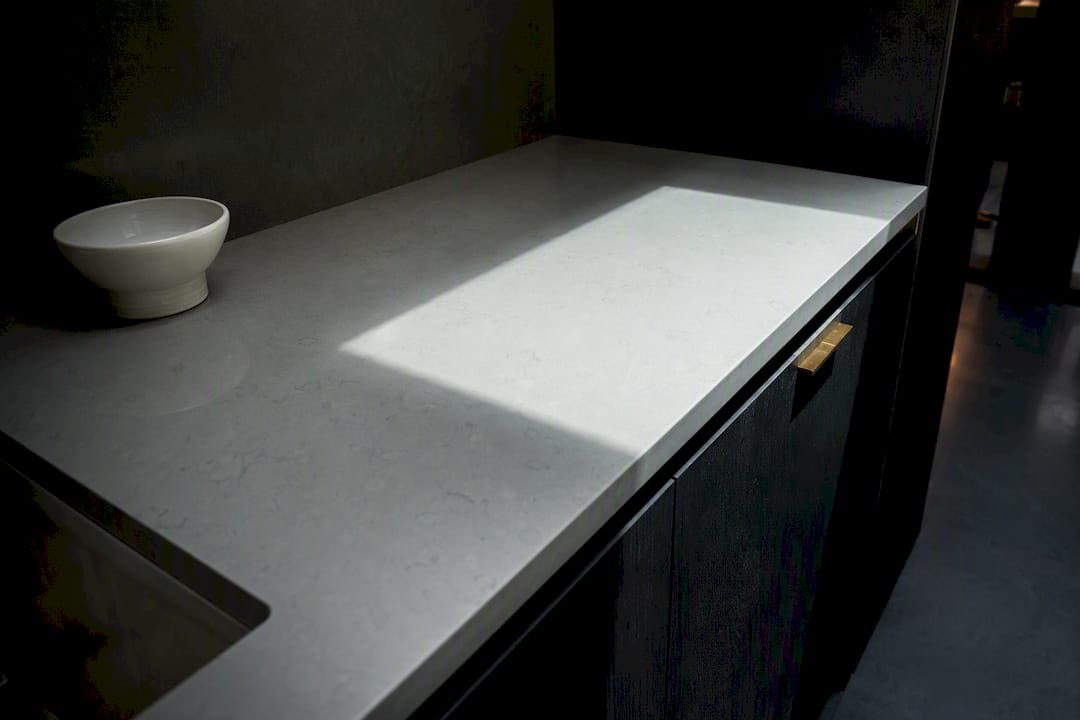
For cleaning, stick to warm water, mild dish soap, and a soft cloth. Avoid bleach-based cleaners and anything abrasive. If you see a chip, discolouration, or a seam starting to open, call a fabricator rather than attempting a DIY fix. Resin repairs done poorly are often more visible than the original damage.
What drives cost and how long will you wait for material?
Neither Caesarstone nor Silestone publishes a single price per square foot that applies across the board, because cost depends on far more than the brand name.
- Collection tier: entry-level colourways cost meaningfully less than premium or design-forward lines from either manufacturer.
- Slab size and thickness: larger format slabs and thicker profiles (like the popular waterfall-edge look) increase material cost and waste during fabrication.
- Edge detail: a simple eased edge costs less than a mitred waterfall or ogee profile.
- Cutouts: sinks, cooktops, and outlet cutouts add fabrication time and cost regardless of brand.
Availability moves independently of price. A colourway that’s in local stock this month might be back-ordered next month if the batch sells through, and quartz’s upfront cost is often offset by lower long-term maintenance compared with natural stone that needs periodic sealing. Our renovation ROI guide covers how material choices like this play into long-term property value.
Warranty terms typically cover manufacturing defects for a set number of years, but most warranties specify approved fabrication and adhesive methods. If your installer deviates from the manufacturer’s guidelines, that coverage can be voided, which is one more reason fabricator selection matters as much as brand selection.
Fabrication and installation: what to require from your installer
Fabrication quality determines more about your finished counter than the brand stamped on the slab. Multigroup has coordinated countertop selection and installation across enough tenant improvement and renovation projects to know exactly where the failures start.
Template accuracy comes first. A fabricator who templates from the actual installed cabinetry, not from architectural drawings, catches the small discrepancies that cause gap or overhang problems later. Clamping technique and adhesive choice during seam bonding directly affect whether that seam holds over years of thermal expansion and contraction. Overhangs beyond roughly 10 to 12 inches need corbels or bracket support underneath; skipping that support is a common cause of cracking under load.
Scheduling matters just as much as technique. Templating should happen only after cabinetry is fully set and levelled, and coordinating that sequence with plumbing and electrical trades avoids the rework that eats budgets and timelines alike.
A short checklist to bring to your fabricator meeting:
- Ask who physically templates the job, and whether they template from the installed cabinets.
- Confirm the adhesive and seam support method in writing.
- Ask about corbel or bracket support for any overhang past 12 inches.
- Request the manufacturer’s fabrication guidelines and confirm the fabricator is a certified installer for that brand.
Which brand fits your renovation, and a showroom checklist
The right choice usually comes down to the project type more than a blanket brand preference.
- Small condo kitchen: Either brand works well; prioritize a finish that hides fingerprints if the kitchen sees heavy daily use.
- Large island with a waterfall edge: Confirm slab size can span the full waterfall without an extra seam, and check both brands’ large-format slab options before choosing.
- Bathroom vanity: Lower daily wear makes this a lower-risk spot to choose based purely on colour and pattern preference.
- Rental property: Favour a neutral, widely-stocked colourway from either brand so future repairs or replacements are easier to match.
Bring six questions to the showroom or fabricator: slab size, batch number, finish type, edge profile, current lead time, and exactly what the warranty covers if something goes wrong during installation. Get templating quotes from at least two fabricators and ask each for references from a job completed at least a year ago, not last month.
The final call on Caesarstone vs Silestone
If bold pattern and colour variety top your list, lean toward Silestone. If you need architectural neutrals or marble-look consistency across a larger space, Caesarstone’s collections are built for exactly that. Either choice performs comparably well day to day, so don’t let brand loyalty override the more important decision: who’s fabricating and installing the slab.
Before signing anything, view full slabs in person under your project’s actual lighting, get written templating quotes from at least two fabricators, and confirm in writing what the manufacturer’s warranty requires from the installer. Those three steps prevent more disappointment than choosing between these two brands ever will.
Does countertop brand affect resale value?
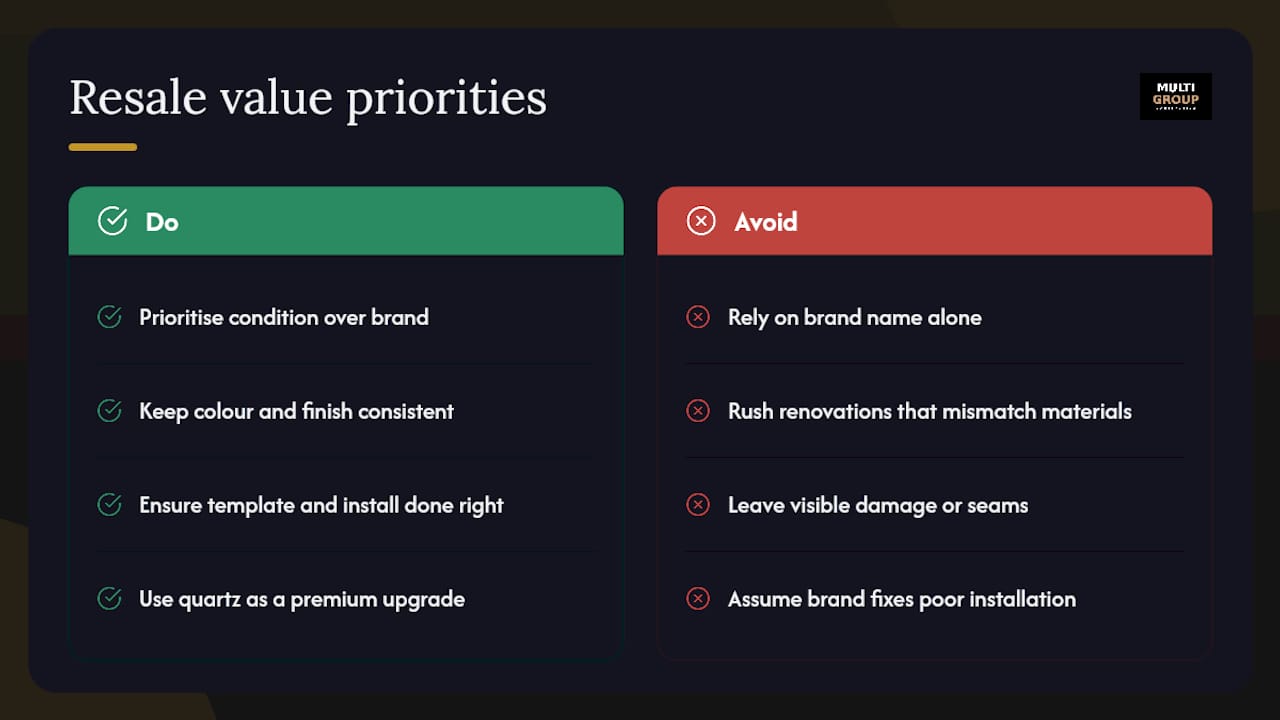
Buyers and real estate agents rarely distinguish between Caesarstone and Silestone by name when evaluating a property. What they notice is whether the counters look current, undamaged, and consistent with the rest of the finish package. A well-installed slab from either brand reads as “quartz countertops,” a feature that appraisers and buyers generally treat as a premium upgrade over laminate.
Where brand can matter slightly is in commercial and multi-unit contexts, where a recognizable name on spec sheets can reassure a buyer or lender that materials meet a documented standard. For a single-family resale, though, condition outranks brand almost every time. A Caesarstone counter with visible seam separation or heat damage will hurt a sale more than a flawlessly installed Silestone slab helps one.
The bigger resale risk isn’t the brand choice at all: it’s mismatched materials from a rushed renovation, or a countertop that clashes with cabinetry and flooring chosen at a different time. Buyers and appraisers respond to a cohesive finish package, not a specific manufacturer’s logo. If resale value is a genuine priority, put your energy into colour and finish consistency across the whole space, and make sure whoever templates and installs the slab does it right the first time. That protects your investment far more reliably than a brand name on an invoice.
Coordinating countertop selection on real projects
Countertop selection can’t happen in isolation on a renovation with real deadlines. Multigroup builds slab selection and fabricator templating into the project schedule alongside permitting and trade sequencing, because a delayed slab delivery or a mistimed template appointment can stall an entire build. Coordinating that decision early, before cabinetry and plumbing rough-ins lock in, is what keeps a renovation on schedule and on budget.
— MultigroupTeam
How Multigroup manages the finishes that make or break a renovation
Choosing between Caesarstone and Silestone is one decision among dozens on a commercial renovation, and it’s exactly the kind of detail that stalls a project when nobody owns the coordination. Multigroup is the general contractor Metro Vancouver property managers, landlords, and operators bring in to own that coordination end to end, from permitting through the final punch list.

Multigroup handles commercial renovation work across Metro Vancouver, including tenant improvements, retail buildouts, warehouse renovations, and restaurant and coffee shop renovations. On every project, that means scheduling fabricator templating around the trades that touch the same space, managing the BC Building Code and municipal permit timeline, and holding fabricators and suppliers to the quality standards your project needs, so a countertop delay or a warranty dispute never derails your opening date. If you’re planning a renovation that needs a contractor who treats finish selection as part of the schedule, not an afterthought, contact Multigroup for a project consultation and templating coordination.
Sources
- Pros and Cons of Quartz Countertops: 2026 MSI Guide
- Quartz countertop repair: chips, burns, and seam separation – Dynamic Stone Tools
- I hate my quartz countertop: what to know
FAQ
What are the negatives of Silestone?
Silestone shares quartz’s general limits: sensitivity to extreme heat and prolonged UV exposure, and a risk of edge chipping from heavy impact. Its bolder, high-contrast patterns can also feel busy in smaller spaces where a quieter surface would work better.
What are the disadvantages of Caesarstone countertops?
Caesarstone carries the same heat and UV sensitivities common to all engineered quartz, and its more neutral, architectural palette offers less dramatic pattern variety than some competing lines. Cost also rises quickly in premium collections and larger slab formats.
Is Caesarstone considered high-end?
Caesarstone is generally positioned as a premium engineered quartz brand, particularly its architectural and marble-look collections favoured on higher-end residential and commercial projects. Entry-level colourways within its range price closer to mid-market quartz.
Which is more expensive, quartz or Silestone?
Silestone is itself an engineered quartz brand, so this isn’t a true either/or; pricing depends on the specific collection, slab size, and edge detail rather than “quartz” versus “Silestone” as separate categories. Premium collections from any quartz brand, including Silestone, generally cost more than entry-level laminate or basic granite.
Does Multigroup help coordinate countertop installation on renovation projects?
Multigroup manages the scheduling, permitting, and fabricator coordination needed to fit countertop selection and installation into a broader commercial renovation timeline, reducing the risk of delays from mismatched trade sequencing.