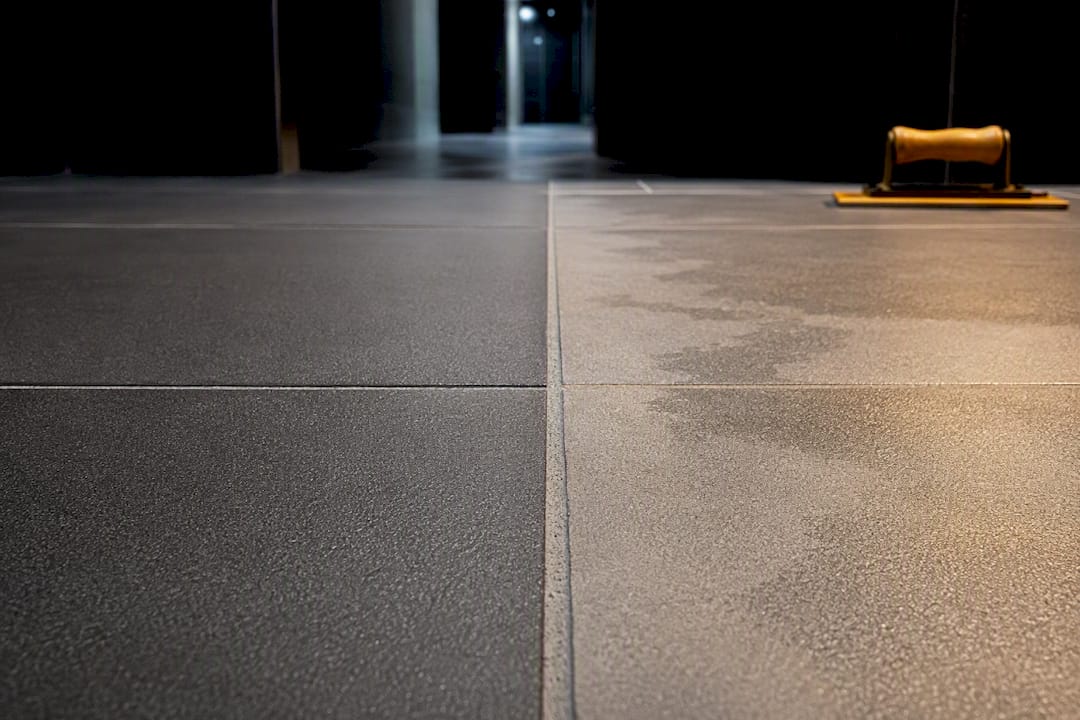
For most commercial and hygiene-sensitive tiling projects, we specify epoxy grout because it delivers superior water, stain, and chemical resistance along with lower lifecycle maintenance. Cement grout still earns its place in dry, low-traffic areas or where sustained high heat rules epoxy out. The trade-off is real: epoxy costs more upfront and demands tighter installation control.
TL;DR:
- Epoxy grout is highly resistant to water, stains, and chemicals, making it ideal for commercial kitchens, wet rooms, and areas with heavy cleaning routines.
- While epoxy costs three to four times more than cement grout, it often reduces lifecycle costs due to less maintenance and fewer resealing requirements.
- Installation of epoxy grout requires small batches, rapid cleanup, specialized PPE, and tighter scheduling, which can increase upfront labor costs.
- Epoxy’s temperature tolerance is limited to around 150°F, so it is unsuitable for high-heat areas or natural stone that is sensitive to solvents.
- Properly installed epoxy grout can last a lifetime with minimal upkeep, whereas cement grout needs regular resealing and is more prone to staining and cracking over time.
Table of Contents
- Epoxy grout vs cement grout: a side-by-side comparison
- How does each grout perform in commercial service?
- What does each grout actually cost over a project’s life?
- How is epoxy grout installed differently from cement?
- Which grout is easier to clean and maintain?
- Which grout fits which commercial application?
- Where does each grout hit material limits?
- What standards and spec language should procurement teams use?
- Multigroup’s checklist for grout decisions on commercial builds
- Publisher perspective: why Multigroup specifies epoxy for commercial clients
- Get grout and tile specifications right the first time
- Sources
- FAQ
Epoxy grout vs cement grout: a side-by-side comparison
Choosing between epoxy and cement grout comes down to how each material cures, how it handles water and chemicals, and what that means for a building’s ongoing costs. Epoxy resists moisture and chemicals better and needs no sealing, but it costs several times more per square foot installed. Cement grout is cheaper and easier to place, but it stays porous and needs periodic resealing.
Epoxy grout cures through a chemical reaction between resin and hardener, producing a dense, non-porous matrix. Cement grout hydrates like concrete, which leaves microscopic pores that absorb water, oil, and staining agents over time. This difference is key to their distinct properties such as cleaning needs and warranty considerations.
| Property | Epoxy grout | Cement grout |
|---|---|---|
| Cure mechanism | Chemical reaction (resin + hardener) | Hydration (water + cement) |
| Water/stain resistance | Very high, non-porous | Moderate, porous, needs sealer |
| Chemical resistance | High, resists most acids and solvents | Low to moderate |
| Compressive/tensile strength | High, better impact and vibration tolerance | Good, but more brittle under load |
| Working time | Short (roughly 45 to 75 minutes per mix) | Longer, more forgiving |
| Material cost multiplier | 3 to 4 times cement grout | Baseline |
| Common commercial uses | Commercial kitchens, healthcare, pools, equipment bases | Offices, lobbies, low-moisture retail floors |
The 3 to 5 times material cost premium for epoxy reflects both raw material pricing and the installed labour required to work within its short pot life. For a property manager comparing bids, that line item needs context: epoxy’s higher sticker price is usually offset by fewer callbacks and less janitorial intervention over the tile’s service life.
How does each grout perform in commercial service?
Epoxy holds up better underwater, chemicals, and heavy foot traffic because its cured matrix has essentially no open pores for contaminants to penetrate. Cement grout absorbs moisture and stains gradually, which shows up as discoloration and grout-line degradation within a few years in busy commercial spaces.
The mechanism matters more than the marketing copy suggests. Epoxy’s resin-hardener reaction creates a plastic-like structure that is non-porous, highly stain and chemical resistant, and typically does not require sealing. Cement grout’s hydration process, by contrast, leaves capillary pores that wick in liquids the moment a sealer wears thin, which happens faster in commercial traffic than most facility budgets anticipate.
Practical effects show up in a few predictable places:
- Water absorption in cement grout accelerates efflorescence and colour shift in wet commercial zones like shower rooms and kitchen prep areas.
- Stain resistance in epoxy holds up against grease, coffee, and cleaning chemicals that would permanently discolour cement grout within months.
- Typical cement grout failure starts as hairline cracking and colour fade; epoxy failure, when it happens, is almost always tied to poor installation rather than material breakdown.
- Compressive and tensile behaviour favours epoxy for equipment bases and heavy-duty floors subject to vibration or impact loading.
Statistic to flag for procurement teams: epoxy’s non-porous structure is also why manufacturers rarely require ongoing sealing, a maintenance line item that recurs indefinitely with cement grout.
For warranty purposes, this distinction matters. A manufacturer’s warranty on cement grout usually assumes a sealing schedule was followed; missing a reseal cycle can void coverage. Epoxy warranties tend to focus on installation defects instead, since the material itself does not degrade the same way. That shifts risk toward the installer’s technique rather than the building’s maintenance program, a point worth raising with any contractor bidding the work.
What does each grout actually cost over a project’s life?
Epoxy grout costs more to buy and install, but it often costs less to own. Material pricing runs three to four times higher than cement, and labour is slower because of short working times. Over a five to ten-year horizon, though, avoided resealing and reduced tile replacement frequently close that gap for high-traffic commercial floors.
The 3 to 5 times material cost multiplier is the number that shows up first in every bid comparison, and it is the one that scares budget holders away from epoxy before they run the full lifecycle math. Installed cost climbs further because epoxy demands tighter quality control, smaller batch mixing, and more careful cleanup than a cement crew is used to.
Labour hours tell a more nuanced story than “epoxy is slower.” Where it matters:
- Mixing and placing epoxy in small batches to respect pot life adds crew time compared to cement’s longer working window.
- Haze removal on epoxy must happen before the material sets, which can require an extra labourer on larger commercial floors.
- Cement grout’s longer open time allows a smaller crew to cover more square footage per shift.
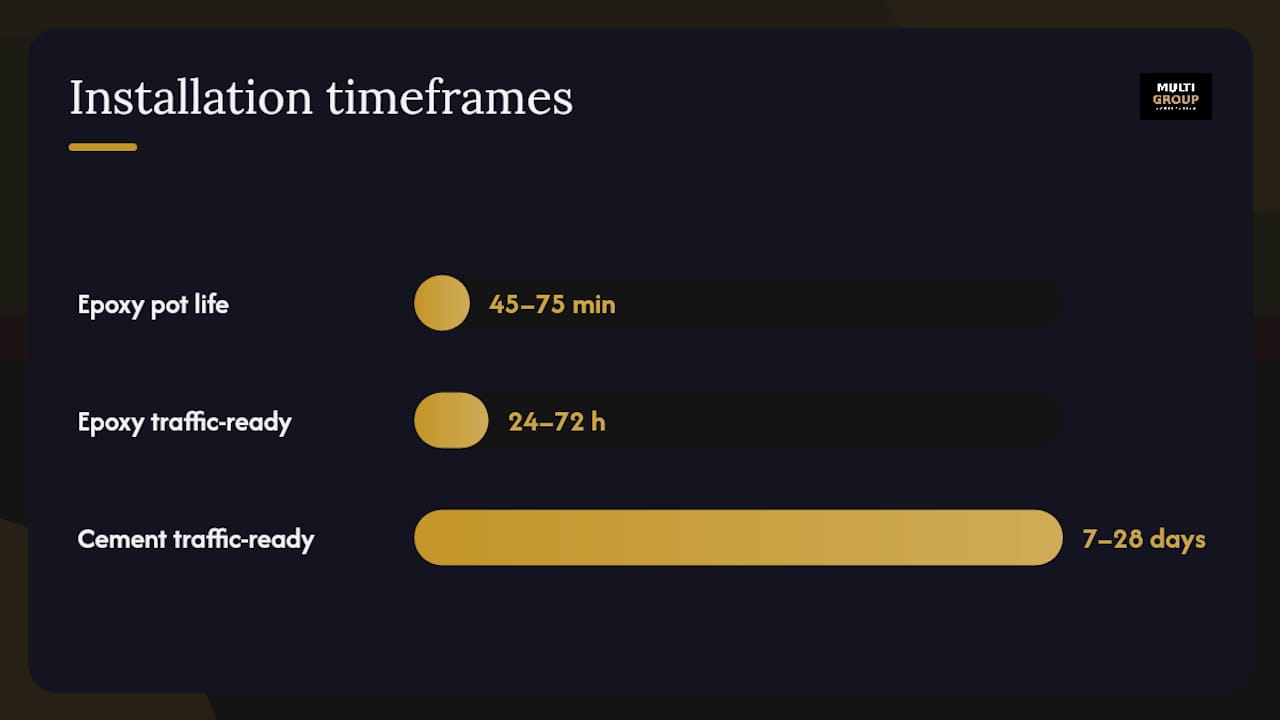
- Epoxy’s faster strength gain, often 24 to 72 hours versus 7 to 28 days for cement, can shorten the return-to-service window on projects where downtime costs more than the material premium.
For a facility manager weighing the premium, the ROI question is straightforward: how many hours of closure or lost revenue does a faster return to service save, and how many resealing cycles and grout replacements does non-porous epoxy avoid over the next decade? For a commercial kitchen or a 24-hour retail floor, that math usually favours epoxy. For a low-traffic office corridor, cement often remains the more sensible spend.
How is epoxy grout installed differently from cement?
Epoxy installation demands tighter staging and faster execution because pot life is short and haze must be removed before cure. Cement grout offers a longer working window but needs a distinct sealing step and a multi-day cure before it reaches full strength. Both require site-specific phasing when work happens inside occupied buildings.
- Mix in small batches. Epoxy’s pot life runs roughly 45 to 75 minutes per mix, so crews stage multiple smaller batches rather than one large mix, often with more than one worker mixing simultaneously.
- Fill joints and remove haze immediately. Epoxy that sits too long before cleanup requires mechanical removal and a full regrout, a costly rework scenario that installer technique historically caused through pinholes and sagging before formulations improved.
- Check for pinholes before final cleanup. A second pass catches surface voids while the material is still workable.
- For cement grout, float, tool, and clean joints, then apply a penetrating sealer once the grout has cured enough to accept it, typically a few days after installation.
- Allow appropriate cure time before load or traffic. Cement grout may need 7 to 28 days to reach full design strength for heavy loads, while epoxy is often ready in 24 to 72 hours.
Epoxy resin is a documented skin irritant, and manufacturers require gloves, eye protection, and adequate ventilation during mixing and application. Any commercial spec should require this PPE explicitly, along with a cleanup protocol for spills.
Phasing inside an occupied building changes the calculus further. Epoxy’s fast cure can actually reduce tenant disruption on a floor-by-floor retrofit, since sections return to service sooner. Cement grout’s longer cure window may require closing an area for a full week, which matters when negotiating access with an operating restaurant tenant or a strata council overseeing common area work.
Pro Tip: Ask any epoxy installer for a sample mock-up panel before the job starts. Pot life and haze removal are technique-dependent, and a two-square-foot test tells you more about a crew’s competence than any brochure.
Which grout is easier to clean and maintain?
Epoxy needs almost no ongoing maintenance beyond routine cleaning, since it does not absorb moisture or stains and typically skips sealing entirely. Cement grout requires a sealing schedule, usually every one to two years in commercial traffic, and is more sensitive to which cleaning chemicals you use on it.
Facilities teams managing food service or healthcare spaces benefit most from this difference. Because epoxy’s joints stay non-porous, they tolerate aggressive sanitizers without breaking down, which matters when a commercial kitchen’s cleaning protocol calls for daily disinfectant use.
Maintenance planning differs by material:
- Epoxy grout tolerates most standard commercial cleaners and disinfectants without degrading, simplifying janitorial contracts.
- Cement grout can be damaged by acidic or highly alkaline cleaners, so janitorial staff need product-specific guidance to avoid accelerating wear.
- Sealing cement grout on a one to two-year cycle is a recurring line item that facility budgets must plan for indefinitely.
- Epoxy’s sanitation profile makes it the default in restaurant kitchens, medical clinics, and washrooms where cross-contamination risk carries regulatory weight.
Which grout fits which commercial application?
Wet, hygiene-critical, and chemically exposed spaces call for epoxy. Dry, low-traffic, or extreme-heat applications often do better with cement. The right choice depends on moisture exposure, cleaning chemical use, and how much downtime a reseal cycle would cost the operation.
- Commercial kitchens: choose epoxy for grease and sanitizer exposure; cement is rarely appropriate here.
- Showers and wet rooms: choose epoxy for water resistance and reduced mould risk; cement requires diligent sealing to compete.
- Pools and pool decks: choose epoxy for chemical resistance to chlorine and constant moisture.
- Heavy-duty floors and equipment baseplates: choose epoxy for its impact and vibration tolerance, though cementitious grout still performs better under sustained high heat or where large-volume flowability is needed.
- Public washrooms: choose epoxy where sanitation and stain resistance are priorities.
- Low-traffic offices and dry retail floors: cement remains a cost-effective, defensible choice.
Exceptions matter here. Sensitive natural stone and areas with sustained temperatures above epoxy’s service limit both push the decision back toward cement, covered in the next section.
Where does each grout hit material limits?
Epoxy has real compatibility constraints that specifiers need to flag before bidding: sensitive natural stone, sustained high heat, and certain UV exposures. Cement grout has its own limits around porosity and colour consistency, but its failure modes are more forgiving and easier to correct after the fact.
- Some porous or acid-sensitive natural stones can be damaged by epoxy’s cleaning solvents during installation; a sealed, tested sample panel is worth the extra day before full production.
- Epoxy grout has a continuous service temperature limit of roughly 150°F (65°C), while cementitious grouts tolerate sustained high heat better in industrial settings.
- UV exposure can affect colour stability in some epoxy formulations; check manufacturer datasheets for exterior or skylight-adjacent applications before specifying.
- For high-end stone or mosaic work where appearance is paramount, review premium grout and mosaic options alongside the tile supplier’s own compatibility guidance.
What standards and spec language should procurement teams use?
Bid documents should require compliance with ANSI A118.3 for epoxy grout and specific manufacturer chemical-resistance charts for both materials. Vague specification language is the single most common cause of grout disputes on commercial projects, more so than the material choice itself.
- Reference ANSI A118.3 compliance explicitly and require the manufacturer’s current datasheet with the bid.
- Sample epoxy spec line: “Epoxy grout shall meet ANSI A118.3 and include manufacturer chemical-resistance chart for specified cleaning agents.”
- Sample cement spec line: “Cementitious grout shall be sealed per manufacturer schedule within 72 hours of install; sealer product and reapplication interval to be submitted with bid.”
- Require documentation of cure schedule, maintenance guidance, and written warranty terms from every bidder before award.
Multigroup’s checklist for grout decisions on commercial builds
Budget conversations on tile packages go sideways when grout is treated as an afterthought. A defensible commercial spec accounts for the material premium, the staging plan, and who owns the janitorial handover once the tenant moves in.
- Budget line items: material premium for epoxy, staging and small-batch mixing labour, mock-up panel cost, and a janitorial handover package outlining approved cleaners.
- Scheduling items: staging sequence around pot life, cure windows before return to service, and coordination with tenants or strata for phased area closures.
- Contract clauses: required mock-up approval before full production, warranty terms tied to installation defects versus maintenance lapses, acceptance criteria for haze and pinhole inspection, and movement joint locations that trigger a change order if missed in the original scope.
These items belong in the tenant improvements scope document from day one, not negotiated after tile is already set.
Publisher perspective: why Multigroup specifies epoxy for commercial clients
Our default recommendation is epoxy for any space touching food service, healthcare, or sustained moisture. We shift to cement only when heat exposure, budget constraints, or stone sensitivity make it the sounder call. If you are drafting a spec and want a second opinion on the tradeoffs, contact Multigroup before the bid goes out.
— MultigroupTeam
Get grout and tile specifications right the first time
Getting grout specifications wrong on a commercial build means callbacks, tenant complaints, and change orders nobody budgeted for. Multigroup handles the full scope, not just the tile package, across tenant improvements, retail buildouts, restaurant and coffee shop renovations, and warehouse renovations where equipment baseplates and heavy floors demand a different grout strategy than a retail showroom.

Because we manage the whole build, grout choice gets decided alongside base building versus tenant scope, permit sequencing, and the BC Building Code requirements governing occupied-building phasing, not in isolation after the tile is ordered. If you have a commercial tiling package coming up, whether it is a single restaurant fit-out or a multi-floor retail rollout, request a project review and we will walk through material selection, staging, and budget line items before your bid documents go out.
Sources
- Epoxy grout: everything you need to know | LATICRETE
- Pros and cons of epoxy grout | JLC
- Epoxy grout vs. Cement grout: Pros and cons - RUBI
FAQ
What are the disadvantages of epoxy grout?
Epoxy costs three to four times more in materials, has a short pot life that demands skilled installation, and can be a skin irritant requiring PPE during application. It also has a lower continuous heat tolerance than cement, around 150°F (65°C).
Can I use epoxy grout over old grout?
Epoxy can be applied over existing grout only after the old grout is fully removed and the joint is cleaned to bare substrate; epoxy will not bond reliably over failing or contaminated cement grout. Surface prep, not the epoxy itself, determines whether a regrout job succeeds.
How long will epoxy grout last?
Properly installed epoxy grout can last the lifetime of the tile installation with minimal maintenance, since its non-porous structure resists the staining and degradation that shortens cement grout’s service life. Most failures trace back to installation defects rather than material breakdown over time.
Which is better, cement grout or epoxy grout?
Epoxy is generally the better choice for commercial, hygiene-sensitive, and chemically exposed spaces because of its resistance to water, stains, and chemicals. Cement grout remains a reasonable, lower-cost choice for dry, low-traffic areas or where sustained high heat is a factor.