
Choose fixed-price when your drawings are coordinated, your selections are finalized, and the scope won’t move. Choose cost-plus when site conditions are unknown, design is still evolving, or you need flexibility to adjust as work progresses. A fixed-price contract shifts overrun risk to the contractor; a cost-plus arrangement keeps that risk with you, the owner, in exchange for full cost transparency.
Before signing anything, do two things:
- Score your project’s readiness. If drawings, finishes, and site conditions are locked down, fixed-price protects your budget. If any of those are still in flux, cost-plus avoids paying for uncertainty you can’t yet quantify.
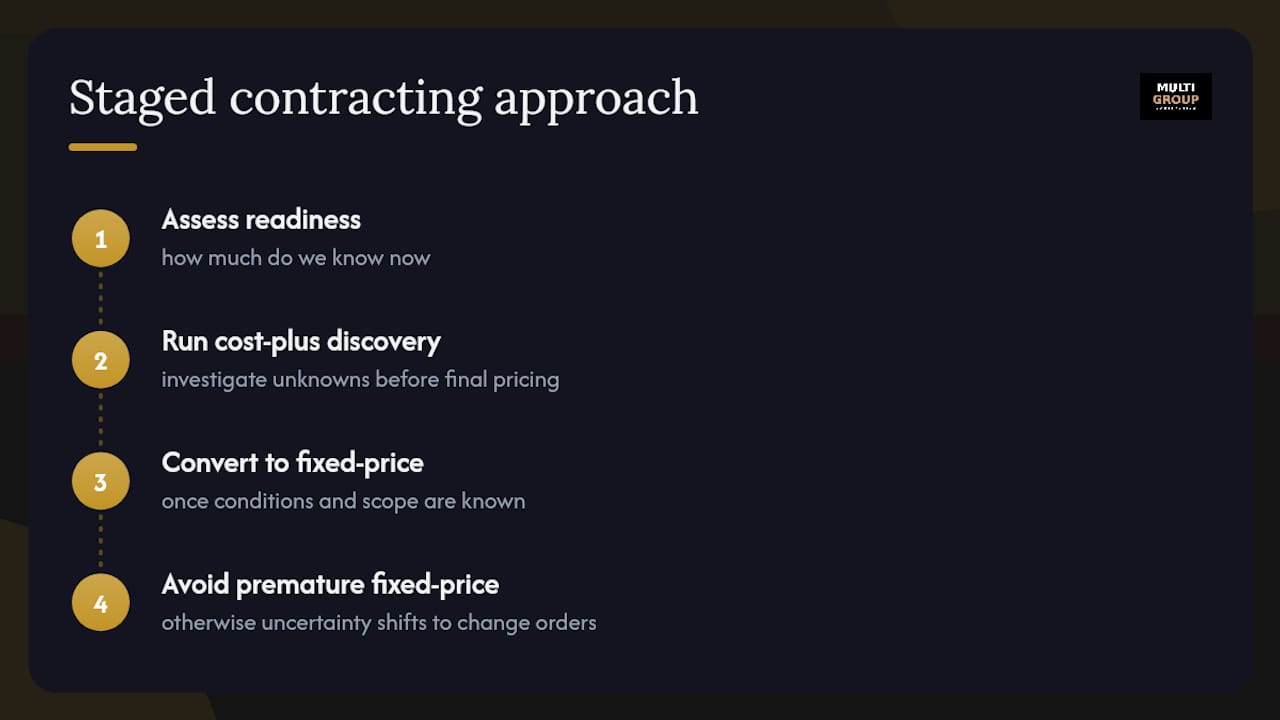
- If you’re genuinely unsure, ask about a staged approach. Many Metro Vancouver projects run cost-plus through demolition and discovery, then convert to fixed-price once the unknowns are gone.
Key Takeaways
The right contract choice depends on how well-defined your project scope is, not on which model sounds simpler or cheaper on paper.
| Point | Details |
|---|---|
| Match contract to readiness | Fixed-price suits finalized drawings and selections; cost-plus suits unknown site conditions or evolving scope. |
| Risk sits somewhere | Fixed-price shifts overrun risk to the contractor; cost-plus keeps it with the owner in exchange for transparency. |
| Cost-plus needs documentation | Courts require diligent records under cost-plus; insist on itemized invoices and audit rights. |
| Consider a staged approach | Run investigative work as cost-plus, then convert to fixed-price once conditions are confirmed. |
| Multigroup reviews readiness first | Multigroup assesses drawing coordination and site conditions before recommending a contract structure for TI and commercial projects. |
Table of Contents
- What is the difference between fixed-price and cost-plus?
- Fixed-price vs cost-plus: weighing the real trade-offs
- Who bears the risk when costs run over?
- How do you choose the right contract for your project?
- What clauses should be in your contract?
- How do you keep costs and schedule on track once work starts?
- How Multigroup helps you choose and manage the right contract
- Authoritative readings and legal guidance
- What owners get wrong about fixed price vs cost plus
- Get the right contract structure for your Metro Vancouver project
- Sources
- FAQ
What is the difference between fixed-price and cost-plus?
A fixed-price contract (also called lump sum) sets one total price for a clearly defined scope of work. You know the number before the first wall comes down, and that number doesn’t move unless you change the scope. The contractor absorbs the risk of underestimating labour, materials, or time, which is exactly why fixed-price bids typically carry a built-in profit margin to cover that exposure, according to federal procurement pricing guidance.
A cost-plus contract reimburses the contractor for actual project costs, labour, materials, subtrades, equipment, plus an agreed fee on top. That fee usually takes one of three forms:
- Percentage of cost: the fee grows as the job grows, which can blunt the contractor’s incentive to control spending.
- Fixed fee: a flat dollar amount regardless of final cost, which keeps the contractor’s compensation predictable even as the project’s cost fluctuates.
- Fixed fee with a guaranteed maximum price (GMP): the contractor caps total exposure at an agreed ceiling, giving the owner a backstop while retaining cost-plus flexibility below that number.
Picture a restaurant buildout with finalized architectural drawings and a locked equipment list. That’s a fixed-price candidate. Now picture a warehouse renovation where nobody knows what’s behind the existing mezzanine framing until demolition starts. That’s a cost-plus situation, at least until the unknowns get resolved.
Fixed-price vs cost-plus: weighing the real trade-offs
Fixed-price advantages:
- You get cost certainty from day one, which makes financing and lender conversations far simpler.
- Administration is lighter. You’re not reviewing invoices weekly or approving purchase orders.
- The contractor has a direct financial incentive to control costs and work efficiently, since savings stay with them.
Fixed-price disadvantages:
- Change orders get expensive fast, because any scope shift outside the original contract reopens pricing negotiations.
- The quoted price includes contingency and markup for risk the contractor is absorbing, so you’re paying for uncertainty even when nothing goes wrong.
- Scope disputes are common when drawings or specifications leave room for interpretation.
Cost-plus advantages:
- You see actual costs, invoices, subtrade pricing, material receipts, with far less guesswork than a lump-sum bid.
- If the contractor negotiates a better price on flooring or fixtures, that savings can flow back to you rather than padding the contractor’s margin.
- Design changes mid-project don’t trigger the adversarial change-order fights that plague fixed-price jobs.
Cost-plus disadvantages:
- Your final cost isn’t locked in, which makes budgeting harder and can strain financing arrangements.
- You carry an administrative load: reviewing invoices, tracking commitments, approving purchase orders on an ongoing basis.
- Without disciplined oversight, costs can drift upward with little natural resistance from either party.
Who bears the risk when costs run over?
Fixed-price contracts push overrun risk onto the contractor. That’s precisely why experienced contractors build contingency into their bids, typically including a margin to cover risk depending on project complexity, rather than absorb an open-ended loss if material prices spike or unforeseen conditions surface. You pay for that risk transfer to cover potential overruns.
Cost-plus flips the arrangement. You pay actual cost plus fee, so if the framing crew hits rock where the soil report said there’d be none, that expense lands on your invoice, not the contractor’s bottom line. The upside is symmetrical: if the electrician finishes under budget, you keep the difference.
That flexibility isn’t a licence for the contractor to spend freely. Canadian courts have made this explicit. In a decision involving a cost-plus dispute, the court confirmed that a cost-plus contract is not equivalent to a blank cheque, reinforcing that contractors owe owners diligent record-keeping and defensible costs, not just a running total.
- Contractors on fixed-price jobs profit from efficiency; contractors on cost-plus jobs are compensated regardless of efficiency unless the fee structure ties incentives to performance.
- That difference is why owners on cost-plus projects need reporting discipline built into the contract from the start, not added after costs start climbing.
How do you choose the right contract for your project?
Run through this checklist before you commit to either model:
- Are your drawings coordinated and complete, or are there still gaps between architectural, structural, and mechanical plans?
- Have finishes, fixtures, and equipment been finalized, or are you still shopping options?
- Do you know what’s behind existing walls, under the slab, or above the ceiling?
- Is there a hard budget ceiling you cannot exceed under any circumstances?
A small, well-defined residential renovation with finalized selections is a natural fit for fixed-price. A tenant improvement in a decades-old commercial building, where nobody’s opened the ceiling tiles yet, usually isn’t. Construction-law commentary from Aird & Berlis notes that many disputes trace back to owners and contractors choosing a contract type that didn’t match how much was actually known about the project.
There’s a middle path many Metro Vancouver owners use successfully: run the demolition and investigative phase on cost-plus, then convert to a fixed-price contract once conditions are confirmed and drawings can be finalized around them. This staged approach, sometimes described as design-build compared to bid-build in procurement circles, lets you avoid guessing at unknowns while still landing on price certainty for the bulk of the job.
Pro Tip: Ask your contractor to put a not-to-exceed cap on the investigative phase before work starts. That way, even the “unknown” portion has a ceiling while you gather the information needed to convert to fixed-price.
What clauses should be in your contract?
For fixed-price contracts, insist on a scope of work detailed enough that neither party can argue about what’s included. Every allowance, flooring, lighting, hardware, should be itemized with a dollar figure, and the change-order pricing method (unit rates, markup percentage, or time-and-materials) should be spelled out before you sign.
For cost-plus contracts, the contract needs to define exactly what counts as a reimbursable cost, how the fee is calculated, and whether you retain a right to audit invoices and time sheets. A properly drafted GMP clause needs explicit inclusions and exclusions and a clear description of how contingency and allowances apply toward the cap; a vague ceiling is effectively unenforceable.
Documentation to require regardless of contract type:
- Itemized invoices tied to specific cost codes, not lump summaries.
- Time sheets for labour billed on a cost-plus basis.
- Copies of purchase orders and subtrade contracts.
- A commitment register showing costs committed but not yet invoiced, so your forecast reflects real exposure.
How do you keep costs and schedule on track once work starts?
Cost-plus projects need an open-book rhythm: weekly or monthly reporting that separates invoiced costs from committed costs, with owner sign-off required before scope changes proceed. Skipping this step is the single most common way cost-plus budgets drift.
Fixed-price projects need the opposite discipline: a strict change-order workflow where nothing gets built until pricing is approved in writing, plus a running reconciliation of allowances against actual selections. If your allowances run short partway through, you want to know at month two, not at final walkthrough.
- On larger commercial jobs, an independent quantity surveyor or periodic third-party audit adds a layer of protection worth the fee, especially on cost-plus work above roughly $500,000.
- Both models benefit from a defined decision-approval chain: who signs off on changes, and how fast.
Pro Tip: Request a two-week look-ahead schedule alongside your cost reports. Cost control and schedule control are the same conversation; a delay almost always shows up as a cost overrun eventually.
How Multigroup helps you choose and manage the right contract
Multigroup runs a project-readiness review before recommending a contract structure, checking drawing coordination, permit status, and known site conditions against BC Building Code requirements. That assessment shapes whether a fixed-price bid or a cost-plus arrangement actually serves your project.
- Cost-estimation and permit handling for tenant improvements, retail buildouts, and commercial renovations across Metro Vancouver.
- Documented change-order administration with itemized allowances and clear approval workflows.
- Open-book cost reporting on cost-plus and staged projects, including commitment registers and invoice tracking.
Owners planning a tenant improvement or commercial renovation can start the procurement conversation with a readiness assessment rather than a blind bid request.
Authoritative readings and legal guidance
- PIHL’s comparison of fixed-price and cost-plus contracts for reporting and audit-rights checklists.
What owners get wrong about fixed price vs cost plus
The conventional advice treats this as a binary choice you make once, at signing, and live with. That’s backwards. The better question isn’t “which contract type is better,” it’s “how much do we actually know about this project right now,” and that answer often changes between the letter of intent and the first site walkthrough.
Owners also tend to assume fixed-price is automatically the “safe” choice because the number is locked in. It’s safe only if the scope behind that number is genuinely locked in too. A fixed-price contract signed against incomplete drawings just moves the uncertainty into change-order negotiations later, usually at a worse price than if you’d priced it upfront.
What deserves more attention is the staged model. Running discovery work under cost-plus, then converting to fixed-price once conditions are known, gets dismissed as complicated. In practice, it’s often the only structure that actually matches how commercial buildings behave once you open the walls. Prioritize an honest readiness assessment before you argue about contract type. The paperwork follows from that, not the other way around.
Get the right contract structure for your Metro Vancouver project
Multigroup is the practical alternative to signing a bid before you know what you’re actually buying. Rather than pushing every client toward a single contract type, Multigroup starts with a readiness review of your drawings, permits, and site conditions, then recommends fixed-price, cost-plus, or a staged structure based on what your project actually needs, not what’s easiest to quote.
That approach shows up across Multigroup’s work on retail buildouts, restaurant and coffee shop renovations, and office renovations throughout Metro Vancouver, where scope certainty varies enormously from one lease space to the next. Owners get itemized allowances, documented change-order pricing, and open-book reporting where cost-plus applies, all administered under BC Building Code compliance and full permit handling. If you’re planning a project and aren’t sure which contract fits, request a project-readiness review from Multigroup before you request bids. It’s the step that determines whether the number you sign actually holds.
Sources
- Here’s The Drill: The Court In Sjostrom Sheet Metal Ltd. v. Geo A. Kelson Company Limited Confirms That A Cost-Plus Contract Is Not Equivalent To A Blank Cheque - Construction & Planning - Canada
- Practitioner’s Guide for Procurement Pricing (CanadaBuys)
- Fixed price or cost plus? A tale of two construction project payment arrangements (Aird & Berlis)
FAQ
What is the difference between fixed-price and cost-plus?
A fixed-price contract sets one total price for a defined scope, with the contractor absorbing overrun risk. A cost-plus contract reimburses actual costs plus a fee, with the owner bearing the risk of cost changes.
What does cost-plus 6% mean?
It means the contractor is paid actual project costs plus a fee calculated as a percentage of those costs, one common form of the percentage-of-cost fee structure used in cost-plus contracts.
What is a fixed-fee cost-plus contract?
It’s a cost-plus arrangement where the contractor’s fee is a flat dollar amount agreed in advance, rather than a percentage of costs, so the contractor’s compensation doesn’t grow if the project’s cost does.
What is a common disadvantage of cost-plus contracts?
Budget uncertainty is the main drawback, since the final cost isn’t fixed and owners need ongoing invoice review and reporting to keep spending in check, as court guidance on cost-plus documentation makes clear.
Can I switch from cost-plus to fixed-price partway through a project?
Yes. Many Metro Vancouver projects start cost-plus during demolition or investigative work, then convert to fixed-price once drawings and site conditions are confirmed, a staged approach construction-law commentary recognizes as a practical way to avoid disputes over mismatched contract types.