Hardie board is the better siding if you’re staying put for the long haul, live somewhere hail or wind can do real damage, and care about resale value. Vinyl siding wins if your priority is the lowest upfront cost and close to zero upkeep. That’s the whole decision in one sentence, but the reasons behind it matter, because a $10,000 mistake on the wrong material is easy to make.
- Cost and maintenance favour vinyl: it installs faster, costs less per square foot, and rarely needs anything beyond a hose-down.
- Durability and resale favour Hardie: better hail and fire performance, a longer service life, and stronger buyer perception at sale.
Local factors change the math too. Permit requirements, installation quality, and your specific climate exposure all shift which material actually performs best on your house, and we’ll walk through each one.
Key Takeaways
Hardie board costs more upfront but outlasts vinyl by roughly a decade or two while resisting hail and fire damage that vinyl cannot.
| Point | Details |
|---|---|
| Cost gap | Vinyl runs $6–$14 per sq ft installed; fiber cement runs $12–$18 per sq ft, about 40–50% more. |
| Lifespan difference | Fiber cement lasts 40–50 years versus 20–30 years for vinyl siding. |
| Weather performance | Hardie’s Class 4 impact rating and Class A fire rating outperform vinyl in hail and fire risk zones. |
| Maintenance tradeoff | Vinyl needs occasional washing only; Hardie needs repainting every 10–15 years. |
| Installation matters most | Multigroup Contracting manages permits, flashing, and code compliance so either material performs to its rated lifespan across Metro Vancouver. |
Table of Contents
- Hardie board vs vinyl siding: what fiber cement actually is
- What vinyl siding is, and where standard differs from insulated
- Hardie board vs vinyl cost: what you’ll actually pay
- How hail, wind, and freeze-thaw change the equation
- Maintenance and how long each material actually lasts
- Installing Hardie vs vinyl: what to expect on site
- Hardie board pros and cons versus vinyl siding
- How to choose the right siding for your situation
- Why permits and installation quality matter more than the material
- Getting your siding project scoped, permitted, and built right
- Sources
- FAQ
Hardie board vs vinyl siding: what fiber cement actually is
James Hardie fiber cement siding is made from cellulose fibre, sand, and Portland cement pressed into planks or panels that mimic wood grain, stucco, or smooth modern profiles. In colder regions, the HZ5 formulation is engineered specifically to resist moisture cycling and freeze damage better than standard versions. It’s dense, heavy material, and that density is exactly why it performs the way it does.
- Class 4 impact resistance holds up against hail that would crack lighter cladding
- Non-combustible, carrying a Class A fire rating
- Dimensionally stable across temperature swings, so it won’t warp or buckle
- Available pre-primed or in factory-baked ColorPlus finishes that extend the repaint interval
The tradeoff is weight and handling. Fiber cement siding is heavier and requires specialised cutting tools, and installers who rush the job risk trapping moisture behind the boards.
Pro Tip: Insist that your installer back-prime cut edges and maintain proper flashing at every seam. Hardie board fails early almost exclusively from moisture getting in at butt joints, not from the material itself breaking down.
What vinyl siding is, and where standard differs from insulated
Vinyl siding is extruded PVC formed into interlocking panels, sold across a range of grades from thin builder-basic stock to thicker premium profiles and insulated versions with rigid foam backing. It’s the lightest cladding option on the market, and that alone explains a lot of its popularity.
- Installs quickly with basic tools, cutting labour time and cost
- Requires almost no routine maintenance beyond an occasional wash
- Comes in dozens of colours and textures, though you can’t repaint it the way you can Hardie
The limitations show up over time. Standard vinyl has moderate impact resistance at best and can crack or shatter under large hail. It also expands and contracts with temperature, which causes warping if it’s nailed too tightly.
Pro Tip: If you’re chasing better energy performance, insulated vinyl adds meaningful thermal value and closes some of the performance gap with fiber cement, without the added installed cost of Hardie.
Hardie board vs vinyl cost: what you’ll actually pay
Installed pricing is where the two materials diverge the most, and it’s usually the first question homeowners ask. Standard vinyl runs roughly $6 to $14 per square foot installed, while fibre cement lands between $12 and $18 per square foot. Insulated vinyl sits somewhere in between, typically $9 to $15 per square foot depending on panel thickness and foam backing.
| Home size | Standard vinyl | Insulated vinyl | Hardie fiber cement |
|---|---|---|---|
| — | typical cost range for standard vinyl installed | typical cost range for insulated vinyl installed | typical cost range for fiber cement installed |
| — | typical cost range for standard vinyl installed | typical cost range for insulated vinyl installed | typical cost range for fiber cement installed |
James Hardie siding typically costs 40–50% more installed than vinyl, which is the single biggest factor pushing budget-conscious homeowners toward vinyl on a straight sticker-price comparison.
That total isn’t just the material. Several line items shift the final number:
- Labour, which runs higher for Hardie because of specialized blades and slower install pace
- Waste factor and offcuts, especially on homes with lots of corners or dormers
- Flashing, trim, and soffit work around windows and doors
- ColorPlus factory finish versus site-applied primer and paint
- Disposal of old siding and job-site cleanup
Add permit fees and professional project management on top, and a full exterior job in Metro Vancouver commonly runs a few thousand dollars beyond the raw material and labour estimate.
How hail, wind, and freeze-thaw change the equation
Cost only tells half the story. Weather performance is where fiber cement earns its price premium, particularly in regions that see hail or heavy freeze-thaw cycling.
| Factor | Hardie fiber cement | Vinyl siding |
|---|---|---|
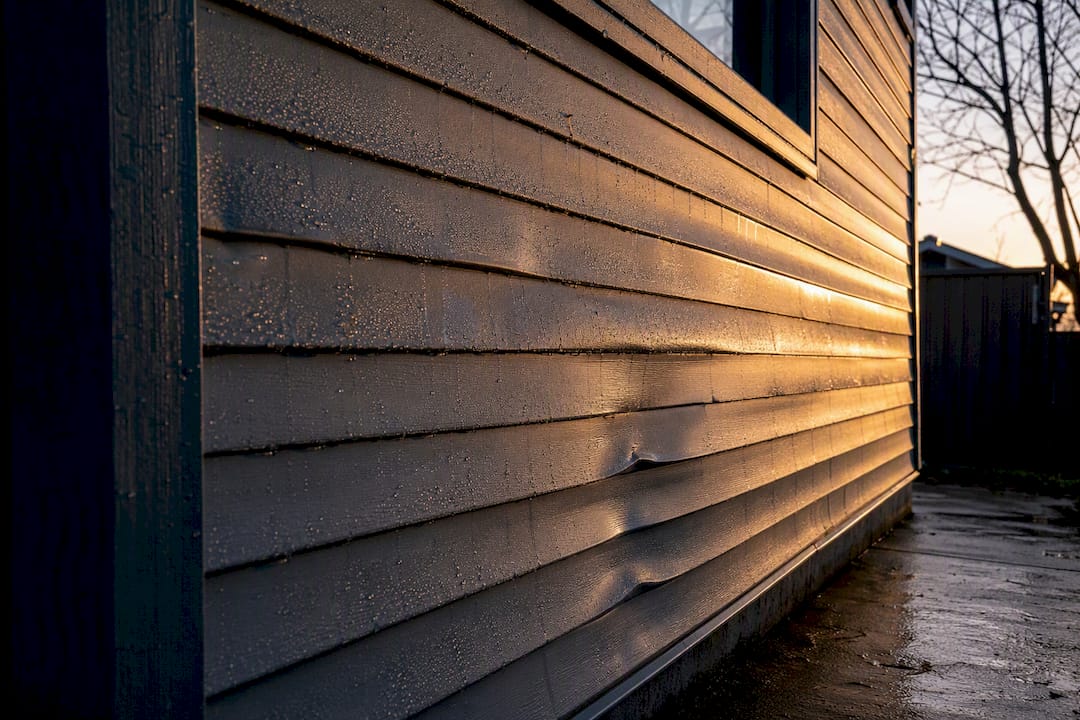
| Hail/impact resistance | Class 4 rated | Moderate; cracks or shatters under large hail |
| Wind resistance | Strong, rigid panels | Good when properly fastened |
| Freeze-thaw stability | Dimensionally stable | Can warp with improper nailing |
| Fire rating | Class A, non-combustible | Combustible, softens near heat |
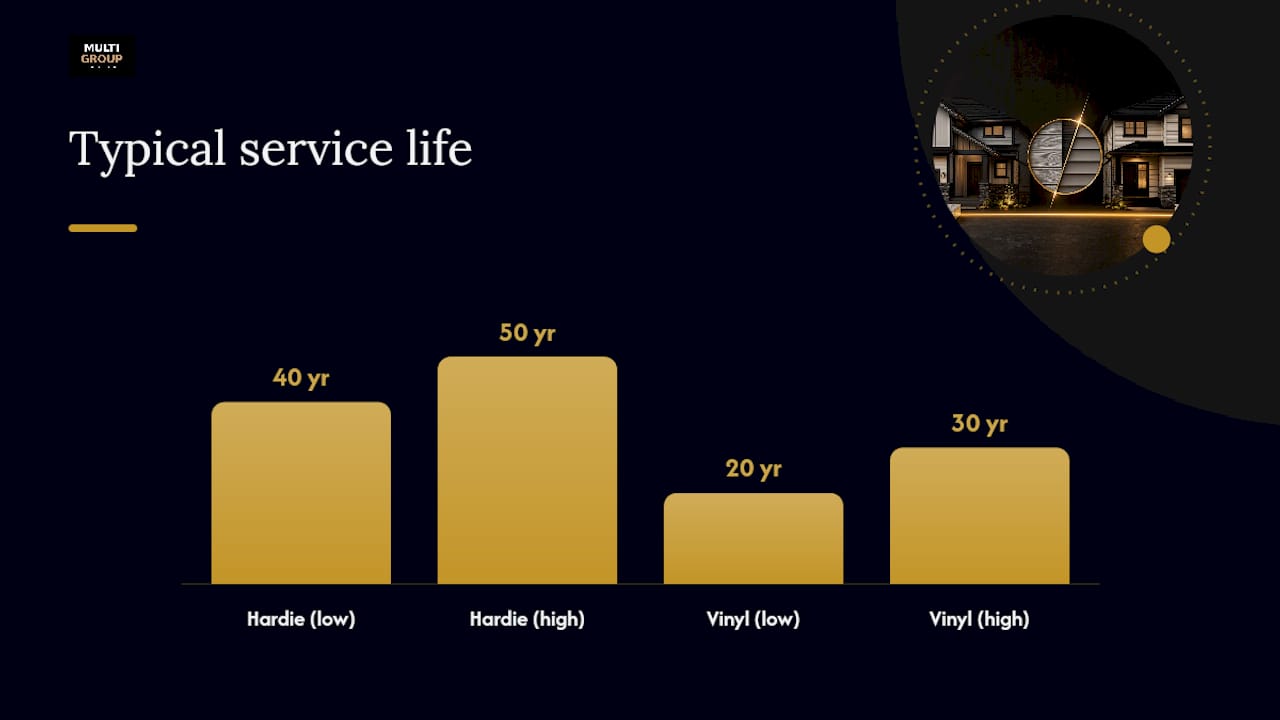
Hardie fiber cement offers superior freeze-thaw stability compared with vinyl, and that stability compounds with lifespan. Fiber cement typically lasts 40 to 50 years, roughly double vinyl’s 20 to 30 year service life.
Climate exposure reorders these rankings fast. A house on a hail-prone prairie street or a coastal lot with salt spray puts more stress on cladding than a sheltered urban infill lot. Repairs differ, too. A cracked Hardie plank gets cut out and replaced as an isolated repair; a warped vinyl panel usually means unzipping and replacing several courses at once because the interlocking profiles don’t patch cleanly.
Maintenance and how long each material actually lasts
Vinyl’s biggest selling point is what you don’t have to do to it. Vinyl generally needs only occasional washing, no scraping, no repainting, no sealing.
- Vinyl: rinse annually, inspect for cracked panels after storms, replace individual sections as needed
- Hardie: wash periodically, expect repainting every 10 to 15 years depending on finish and sun exposure, inspect caulking at joints yearly
- Both: installation quality directly affects whether the manufacturer warranty stays valid, so keep your contractor’s documentation
Lifespan math favours Hardie over a 30-year ownership horizon even with the repaint cost factored in, since you’re not replacing the whole envelope halfway through.
Installing Hardie vs vinyl: what to expect on site
Hardie installation demands more from a crew. It requires diamond-blade saws, careful scoring, scaffolding on multi-storey homes, and strict attention to fastener spacing, all of which slows the job and raises labour cost. Vinyl goes up faster with standard tools and a smaller crew, which is part of why it’s the default choice on tighter timelines.
Before signing a contract, ask bidders:
- Do they install house wrap and proper flashing at every window and door before siding goes on?
- How do they handle butt joints and cut edges on fiber cement to prevent moisture intrusion?
- Will insulated vinyl be nailed loose enough to allow for thermal movement?
- What’s their lead time, and does that include permit approval?
Watch for red flags: overdriven nails that crack vinyl or crush Hardie’s fibre structure, missing flashing, no written warranty, or a crew starting work before permits clear. Every exterior cladding job in Metro Vancouver falls under BC Building Code weather-resistive barrier requirements, and skipping that step is one of the most common sources of the renovation mistakes homeowners run into later.
Hardie board pros and cons versus vinyl siding
| Hardie fiber cement | Vinyl siding | |
|---|---|---|
| Pros | Longer lifespan, better hail/fire resistance, higher resale perception | Lower cost, minimal maintenance, fast installation |
| Cons | Higher upfront cost, needs periodic repainting, heavier install | More vulnerable to hail impact, can warp, limited repainting |
Resale-focused owners and anyone in a hail or wildfire-adjacent zone should weight the Hardie column more heavily. If you’re planning to sell within five years or renovating on a tight budget, vinyl’s lower cost and near-zero upkeep carry more weight for you.
How to choose the right siding for your situation
Run through these questions before committing to either material:
- How long do you plan to own the home? Longer horizons favour Hardie’s lifespan.
- Does your area see hail, high winds, or wildfire risk? That points toward fiber cement’s Class 4 and Class A ratings.
- What’s your total renovation budget, and how much of it can go to the exterior envelope?
- Are you chasing better energy performance? Insulated vinyl or fiber cement over rigid foam both help.
- How much maintenance tolerance do you have for repainting every decade or so?
- Is resale value part of your calculation, even if you’re not selling soon?
Three rough profiles: a budget-conscious first-time owner usually does best with mid-grade or insulated vinyl. A long-term, resale-minded homeowner should lean Hardie despite the premium. A homeowner in a hail-prone or coastal-salt zone should treat fiber cement as the safer bet regardless of budget pressure, because storm damage repair costs erase the upfront savings fast.
Why permits and installation quality matter more than the material
Material choice gets most of the attention, but proper flashing, a continuous weather-resistive barrier, and code-compliant fastening determine whether either siding performs for its full rated lifespan. Skipping any of these steps causes moisture intrusion regardless of whether you chose vinyl or Hardie.
Climate adds another layer. Hail-prone neighbourhoods and coastal lots with salt exposure change your insurance calculus and, in some municipalities, your local code requirements. A mixed-material approach, Hardie on the elevations most exposed to weather and vinyl on protected walls, can stretch a budget further without sacrificing resilience where it counts most.
Pro Tip: Ask your contractor whether a hybrid approach makes sense for your specific lot before assuming it has to be all one material or the other.
A contractor’s view on long-term siding value
Picking a material is only step one. Installation quality and permit compliance decide whether that material hits its rated lifespan or fails at year twelve. Homeowners should weigh resale value and local climate risk alongside sticker price, because the cheapest bid rarely accounts for either.
Getting your siding project scoped, permitted, and built right
Choosing between Hardie board and vinyl is only useful once you have someone who can execute the install correctly, and that’s where a full-service general contractor earns its keep. Multigroup Contracting manages Metro Vancouver residential exterior projects from permit application through final inspection, so the material decision you make above actually delivers the lifespan and warranty protection it promises.

Multigroup’s scope on a siding or full exterior renovation typically includes:
- BC Building Code compliant permit filing and inspection scheduling
- Weather-resistive barrier and flashing installation to manufacturer spec
- Coordination between siding, trim, and window/door trades
- Warranty documentation so your material’s manufacturer coverage stays valid
If you’re weighing Hardie against vinyl for a home in Burnaby, North Vancouver, Surrey, or anywhere across Metro Vancouver, reach out to Multigroup Contracting for a site inspection and a CAD estimate that accounts for your specific exposure, house shape, and permit requirements before you sign with a bidder.
Sources
- Siding installation cost Ontario 2026 | $6–$18/sq ft
- Best siding for Calgary climate — Vinyl vs Hardie
- Vinyl vs James Hardie Siding: Which is Right for Calgary Homes?
- The pros and cons of Hardie board siding for coastal homes
FAQ
What are the negatives of Hardie board siding?
Hardie board costs more upfront, is heavier and harder to install than vinyl, and needs repainting roughly every 10 to 15 years to maintain its finish and moisture resistance.
How much does it cost to Hardie board a 3,000 sq ft house?
Hardie board installation typically costs between $12 and $18 per square foot, with total cost varying depending on trim work, cutouts, and finish choice.
Does Hardie board add R-value?
Standard Hardie board itself adds little insulation on its own, but pairing it with rigid foam backing behind the panels can close much of the gap with insulated vinyl, which adds roughly R-2 to R-5.
What was the main problem with older fiber cement siding?
Older fiber cement products were prone to moisture intrusion at poorly flashed joints and cut edges, which is why proper installation and back-priming remain critical with modern versions.
Is Hardie board or vinyl better for resale value?
Fiber cement generally recoups a higher share of its cost at resale and reads as a premium upgrade to buyers, while vinyl is viewed as standard, budget-friendly cladding.