A small commercial tenant improvement in Vancouver typically draws a building permit fee in the low hundreds to low thousands of dollars, while a mid-size coffee-shop conversion with plumbing and fire-suppression work often lands in the mid-thousands once trade permits are added. Every figure is in CAD, and separate trade and development fees can stack on top of the base building permit. Confirm the exact numbers for your project against the City’s own 2026 schedule of development and building related fees before you finalize a budget.
TL;DR:
- Permit fees in Vancouver are based on a percentage of the declared construction value, with a minimum fee that applies to small projects, which can range from hundreds to thousands of CAD.
- Most projects involving structural changes, occupancy shifts, fire systems, plumbing, electrical, or accessibility upgrades require permits, and skipping these can cause issues during lease or sale processes.
- Fees are typically paid after the application passes a completeness check through Vancouver’s online system, making early planning crucial to manage cash flow effectively.
- Permit costs significantly increase with scope, especially for larger conversions or occupancy changes, and a contingency of 10 to 20 percent is recommended to cover unforeseen upgrades.
- The actual budget risk lies in technical review findings revealing code-triggered upgrades that often surpass initial fee estimates, emphasizing the importance of upfront coordination and contingency planning.
Table of Contents
- How does Vancouver calculate building permit fees?
- Which renovations need a permit in Vancouver?
- How do you apply for a renovation permit and pay the fees?
- How long does a Vancouver building permit take?
- What does a Vancouver permit actually cost? Three examples
- What Multigroup has learned about permit fees on real projects
- Why most permit-fee advice undersells the real risk
- Get your permit and your budget right the first time
- Where to confirm exact permit fees and forms
- Sources
- FAQ
How does Vancouver calculate building permit fees?
The City of Vancouver bases most permit fees on a value formula, charging a rate per $1,000 of construction value with a set minimum that applies even to small jobs. That structure means a $40,000 tenant improvement and a $400,000 buildout pay proportionally different fees, but both hit a fee floor regardless of scope.
The 2026 schedule of development and building related fees is the authoritative source, and it lists several fee categories a commercial renovation client will see on an invoice, not just one lump sum:
- Building permit fee, calculated on declared construction value with a stated minimum
- Plumbing and gas permit fees, billed separately from the building permit under the City’s plumbing and gas permits process
- Electrical permit fees, handled through BC’s electrical permitting stream rather than the building permit itself
- Development permit fees, which apply when a change of use, exterior alteration, or signage is involved
- Inspection and revision fees, charged when drawings change after intake or when re-inspections are required
The City typically requests payment once your application clears its completeness check, according to Get a building permit, and accepts payment online, in person, or by mail with limits on cash transactions. Fees quoted in the schedule are a guide only. The by-laws themselves govern the final amount, so treat any early estimate as a planning number, not a locked-in total.
Which renovations need a permit in Vancouver?
Most structural, life-safety, and occupancy changes trigger a permit in Vancouver, and skipping one on a commercial space almost always surfaces later during a lease transition, insurance claim, or resale. If your scope touches any of the following, plan on a permit application before demolition starts.
- Structural changes — removing or altering load-bearing walls, mezzanines, or floor openings.
- Change of occupancy or use — converting retail space to a restaurant or café, which usually adds fire and plumbing review.
- New or altered fire systems — sprinklers, fire alarms, or suppression systems tied to a kitchen hood.
- Plumbing or gas work — new fixtures, grease interceptors, or gas line changes for cooking equipment, covered under the City’s plumbing and gas permits rules.
- Major electrical upgrades — new service capacity or panel changes to support kitchen or retail equipment.
- Accessibility or life-safety upgrades — washroom modifications, exiting changes, or barrier-free access work.
Some minor, low-risk scopes qualify for streamlined field review or simplified permitting pathways, but a café or restaurant fit-out with a hood and grease interceptor almost never does.
How do you apply for a renovation permit and pay the fees?
You apply through Vancouver Permits Online using the City’s ePlan submission system, and fees are typically requested only after your application passes an initial completeness check, not at the moment you submit it. Building that timing into your cashflow plan matters as much as knowing the fee amount itself.
Start with the City’s commercial renovation checklist before you draft anything, because it flags documents reviewers ask for repeatedly:
- Architectural and consultant drawings coordinated across disciplines
- BC Hydro clearance letters where electrical capacity changes
- Energy code compliance forms for affected assemblies
- Any prior permit history for the unit or building
The application forms and checklists page lists the specific forms by project type, and Multigroup’s own breakdown of the permit process for renovations walks through the sequence in plain language. Once your file is complete, the City issues a fee request tied to your declared construction value, and payment clears the file for technical review.
Pro Tip: Coordinate your mechanical, electrical, and plumbing consultants before submission, not during review. Uncoordinated drawings are the single biggest cause of revision fees on commercial tenant improvements.
For anything beyond a straightforward tenant improvement, a pre-application meeting with City staff is worth the hour. It surfaces code-triggered issues before they become mid-review surprises.
How long does a Vancouver building permit take?
A straightforward tenant improvement permit in Vancouver often clears in a matter of weeks once the file is complete, while a change-of-use or development-linked application can run considerably longer through technical review and revisions. Treat any quoted timeline as a floor, not a guarantee.
Delays cluster around a handful of repeat causes:
- Incomplete submissions that fail the initial completeness check and bounce back to the applicant
- Missing consultant sign-offs, particularly on structural or mechanical drawings
- Code-triggered upgrades discovered mid-review, which restart part of the technical assessment
- General City backlog during high-volume periods
The City has been rolling out digital modernization efforts including ePlan and eCheck tools, and industry observers expect these to gradually ease backlog-driven delays over time. That’s a directional improvement, not a promise of a faster clock on your specific file.
Statistic Callout: Applicants who submit using the City’s own checklists tend to clear the completeness check faster than those who don’t, because reviewers aren’t chasing missing documents before the technical review even starts.
Build a schedule buffer of several weeks beyond the City’s stated review window for anything involving a change of use, and don’t set a lease start date or opening day around the optimistic end of any estimate.
What does a Vancouver permit actually cost? Three examples
Permit-fee ranges shift dramatically with scope, occupancy change, and trade complexity, so a single average figure is close to useless for budgeting. Three realistic project types show how the pieces add up.
- Small tenant improvement (office reconfiguration, no plumbing or occupancy change): expect a base building permit fee in the low hundreds to low thousands, with minimal trade permit add-ons. Carry a modest contingency, since even simple scopes can trigger an unexpected accessibility or exiting requirement.
- Mid-size coffee-shop conversion (new hood, grease interceptor, upgraded electrical service): expect building, plumbing, and fire-related permit fees to combine into the mid-thousands, plus consultant costs for the mechanical and plumbing drawings a hood and interceptor require.
- Larger fit-out with a change of occupancy (retail to restaurant, or substantial interior alteration): development permit fees enter the picture alongside building and trade fees, and consultant costs rise with the added technical review. This is the scenario most likely to surface a mandatory upgrade during review.
Across all three, budget a permit contingency of roughly 10 to 20 percent of your permit-related soft costs. That range covers consultant costs, drawing revisions, and mandatory upgrades that technical review can uncover after your fee is already paid.
What Multigroup has learned about permit fees on real projects
Permit fees rarely show up as a single line item in a bid. Multigroup builds them into the schedule as a phase with its own risk, because a stalled permit delays every trade behind it, and that carries its own cost even before a fee is due.
The cost drivers that repeat across tenant improvement and retail projects are predictable:
- Mandatory fire suppression triggered by a change in occupancy or cooking equipment
- Accessibility upgrades required once a permit application flags existing non-compliance
- Mechanical upgrades needed to support new equipment loads
Multigroup organizes a pre-construction checklist, coordinated consultant drawings, and a documented equipment list before submission, which reduces the odds of a revision cycle or a failed inspection later. This mirrors the approach outlined in Multigroup’s permitting checklist for Vancouver.
Pro Tip: Ask your contractor for a permit-fee and contingency line item separate from construction costs in the bid. It’s the clearest way to see what’s fee, what’s consultant cost, and what’s contingency.
Why most permit-fee advice undersells the real risk
The number on the City’s fee schedule is the easy part. What actually blows up a commercial renovation budget is the gap between the declared fee and what technical review uncovers once a reviewer looks closely at occupancy load, exiting, or kitchen ventilation.
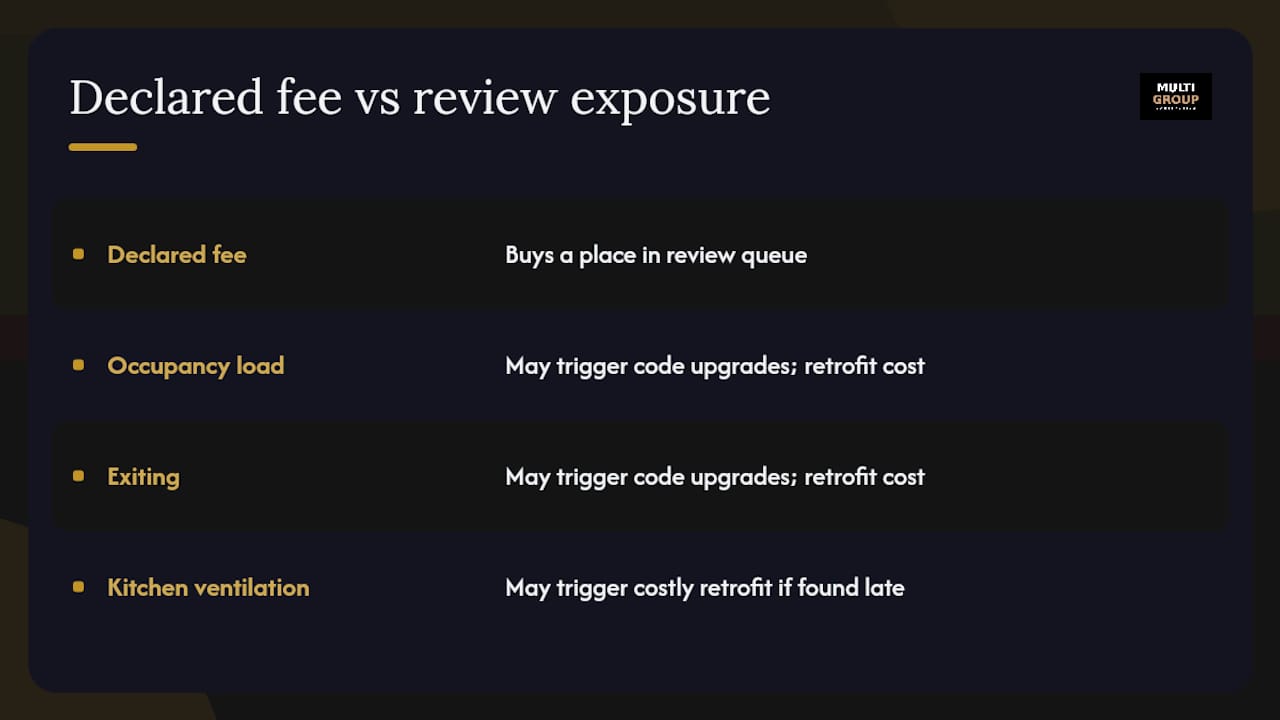
Most online guidance treats the permit fee as the cost of permitting. It isn’t. The fee buys you a place in the review queue; the contingency you carry against code-triggered upgrades is what actually protects your budget. Owners who skip that contingency, or who treat the fee schedule as a final number rather than a starting point, are the ones who call their contractor mid-project asking where an extra $8,000 in required fire work came from.
Prioritize sequencing and consultant coordination before you even think about the fee total. A well-coordinated submission moves through completeness checks faster and surfaces upgrade requirements early, when they’re cheaper to fold into the plan rather than retrofit after demolition has started.
— MultigroupTeam
Get your permit and your budget right the first time
Permit fees are only one line in a commercial renovation budget. The bigger risk is what technical review surfaces after you’ve already committed to a lease date or opening timeline. A general contractor experienced in tenant improvements, retail and restaurant buildouts, and permit management can coordinate consultants, City intake, and trade scheduling to assist property managers and operators.
On every project, coordinating mechanical, electrical, and plumbing drawings before submission, tracking the completeness check, and including a contingency line in the bid for hand sawing services can help prevent revision cycles and inspection failures that impact the schedule. Whether you’re planning a retail buildout, an office tenant improvement, or a broader commercial renovation in Metro Vancouver, get in touch through Multigroup’s contact page to talk through scope, permitting, and a realistic budget before you sign a lease commitment.
Where to confirm exact permit fees and forms
Fee amounts and forms change, so verify specifics directly against the City before you finalize a budget or bid.
- 2026 schedule of development and building related fees for exact fee tables, minimums, and calculation rules
- Get a building permit for the full application process and payment methods
- Application forms and checklists for the specific documents your project type requires
Sources
- 2026 schedule of development and building related fees
- Get a building permit
- Application forms and checklists
- City of Vancouver fees and charges 2026 (UDI commentary)
FAQ
What are the building permit fees in Vancouver?
Building permit fees in Vancouver are calculated on declared construction value with a set minimum, and the exact rates are listed in the City’s 2026 fee schedule. Trade permits for plumbing, gas, and electrical work are billed separately from the base building permit fee.
How much do building permits cost in BC?
Permit fees vary by municipality across BC, since each city sets its own fee schedule under its local by-laws. In Vancouver specifically, the official fee schedule is the only reliable source for current rates.
How much does it cost to renovate a house in Vancouver?
Renovation costs depend heavily on scope, finishes, and whether structural or mechanical work is involved, and permit fees are just one component of the total budget. For commercial projects specifically, Multigroup builds permit fees, trade permits, and a contingency for code-triggered upgrades into every project quote.
Do I need a permit to cut a tree in Vancouver?
Tree removal in Vancouver is governed by the City’s separate tree by-law rather than the building permit process, and most trees on private property require a permit before removal regardless of any renovation work planned nearby. Check with the City directly if a tree stands near your construction footprint, since site work permits and tree permits are handled through different departments.
How long does it take to get a commercial renovation permit in Vancouver?
A straightforward tenant improvement often clears review in a matter of weeks once the application is complete, while projects involving a change of use or development permit take considerably longer. Incomplete submissions and code-triggered upgrades discovered during technical review are the most common causes of delay beyond the initial estimate.